
 Free mini-course · English · Ireland
Manual handling basics
Three short lessons and a final test. About 15 minutes, no sign-up. Your progress stays in this browser.

This module is free and gives no certificate. The full certified course is optional; in Ireland it includes a practical part.
Lesson 1 · What manual handling is and what the law says
Manual handling means transporting or supporting a load — for example lifting, putting down, pushing, pulling, carrying or moving it — where the load or the working conditions create a risk, particularly of back injury. In Ireland this is defined in Regulation 68 of the General Application Regulations 2007.
Avoid manual handling where possible; assess the tasks that remain, using the risk factors in Schedule 3; take measures to reduce the risk; and give employees information and training.
The HSA is clear that training must be specific to the tasks, and that providing training on its own does not meet Regulation 69.
Lesson 2 · Spot the risk factors
Schedule 3 groups the risk factors into five areas. Look at all five before you handle a load.
- The loadToo heavy or too large, unwieldy, difficult to grasp, unstable, or held away from the trunk.
- The physical effortToo strenuous, or done with twisting or sudden movements.
- The working environmentNot enough space, uneven or slippery floors, poor lighting, temperature.
- The requirements of the activityFrequent or prolonged effort, too little rest, long carrying distances.
- Individual factorsThe person's fitness for the task, and whether they have adequate knowledge or training.
Before you start, I have checked…
Lesson 3 · Principles of a safer lift
Where a task cannot be avoided, these good-practice principles reduce the strain on the body. Your employer's risk assessment comes first.
- PlanCheck the route, where the load is going, and whether you need help or a handling aid.
- Stable baseFeet apart, one leg slightly forward, to keep your balance.
- Good holdHold the load close to the waist, with the heaviest side next to your body.
- Natural postureBend the knees and hips rather than stooping over the load.
- No twistingMove your feet to turn; keep shoulders level and facing the same way as the hips.
- Smooth movementLift smoothly and keep control. Put the load down first, then adjust its position.

Load close to the waist, knees bent, back keeping its natural curve.

Stooping over the load with straight legs and the load away from the body.
Heavy or awkward load: plan a team lift.
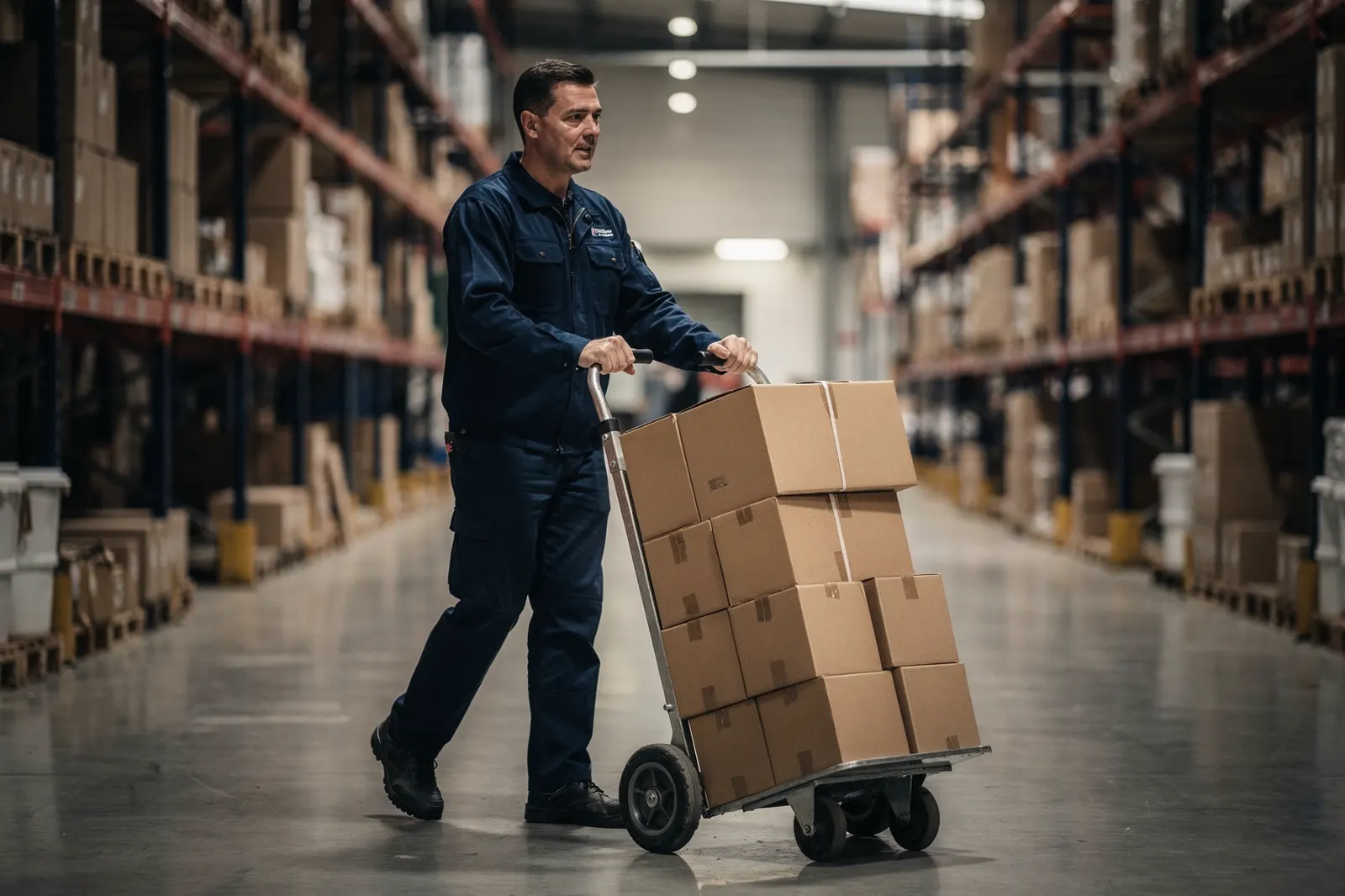
Use a trolley or another handling aid where the task allows.
Final test
Five questions. Pass mark: 4 of 5. You can retry as often as you like.
Well done. This free theory module does not give a certificate.
The full course adds the remaining modules and the certificate. In Ireland it also includes a practical part.
External course website · mysafety.courses · Course-link transparency