← Exit
Module 3 · Hazardous Fumes and Gases0% complete · 15 slides left
Welding Safety
Welding Safety
Module 3
This course contains audio. Use headphones in public places.
Introduction
Introduction

Welding fume is a complex mixture of very fine metal particles and gases. Breathing it in is the most serious long-term health hazard in welding, and it is now recognised as a cause of cancer.

This module explains what welding fume contains, the harm it causes, the legal limits, and how exposure is controlled with extraction, respiratory protection and health surveillance.
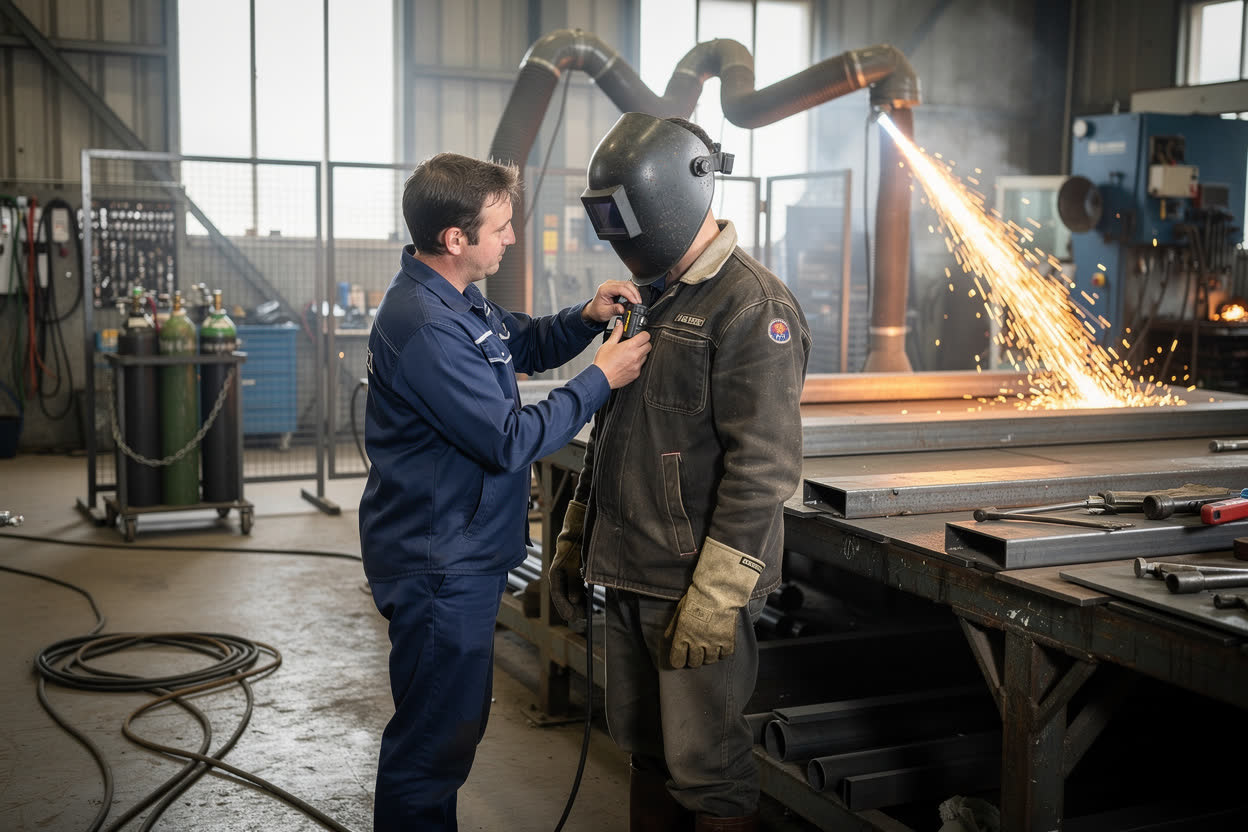
Learning Outcomes
Learning Outcomes

By the end of this module, you will be able to:

  • Describe what welding fume and gases contain.
  • Explain the short-term and long-term health effects of breathing fume.
  • State the legal requirement to control exposure to welding fume.
  • Describe how local exhaust ventilation and respiratory protective equipment control exposure.
What Is in Welding Fume?

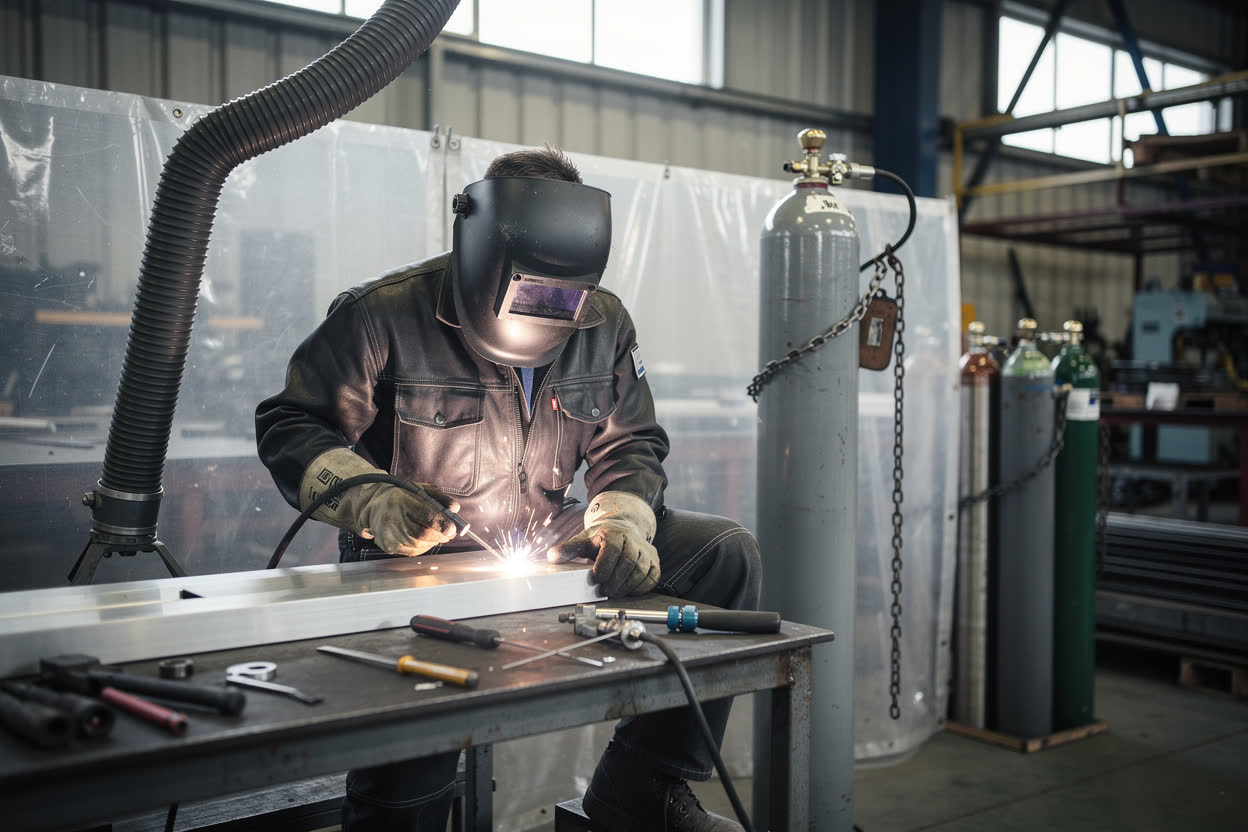
Welding fume contains tiny particles of metal oxides. They come from the metal being welded, from any coating on it, and from the wire or electrode. They can include manganese, chromium, nickel, iron, zinc and copper.

The particles are so fine that they are breathed deep into the lungs. Fume rises in a plume from the arc, so the welder’s head position matters: the closer your face is to the plume, the more you breathe in.

Welding Gases
Welding Gases

Welding also produces or uses gases:

  • Ozone, formed by ultraviolet light from the arc, especially when welding aluminium and stainless steel. It irritates the lungs.
  • Nitrogen oxides, formed by the heat of the arc or flame, which damage the lungs.
  • Carbon monoxide, formed especially with carbon dioxide shielding gas. It is poisonous, and has no smell.
  • Shielding gases, such as argon and carbon dioxide, which can push out the oxygen in enclosed spaces.
Welding Fume Causes Cancer

Welding fume, including fume from mild steel, is classified as a human carcinogen, which means it causes cancer. The International Agency for Research on Cancer places it in its highest group, Group 1.

In Great Britain, employers must control exposure to welding fume under the Control of Substances Hazardous to Health Regulations 2002, known as COSHH.

Control for All Indoor Welding

Since 2019, the Health and Safety Executive, or HSE, has required suitable exposure control for all welding fume, including mild steel.

  • All indoor welding needs suitable exposure control, usually local exhaust ventilation, or LEV.
  • Where LEV alone does not control exposure adequately, respiratory protective equipment, or RPE, is needed as well.
  • Welding outdoors needs RPE.
  • General ventilation, such as an open door or window, is not enough on its own.
Short-Term Health Effects

In the short term, breathing welding fume and gases can cause:

  • Irritation of the eyes, nose, throat and chest.
  • Metal fume fever, a flu-like illness, especially after welding zinc-coated metal.
  • Headaches, dizziness and nausea.
  • Coughing, wheezing and shortness of breath.

If you notice any of these symptoms, tell your supervisor. They are a warning that exposure is not being controlled.

Long-Term Health Effects

Repeated exposure over months and years can cause serious, lasting illness:

  • Lung cancer, and possibly kidney cancer.
  • Chronic obstructive pulmonary disease, and reduced lung function.
  • Occupational asthma.
  • Damage to the nervous system from manganese, with symptoms similar to Parkinson’s disease.
  • Permanent breathing difficulties.

These diseases may not appear for many years, so controls must be used every time.

Exposure Limits
Exposure Limits

Workplace exposure limits for substances in welding fume, such as manganese, are published by the HSE in its guidance EH40, Workplace Exposure Limits.

Exposure must be kept below these limits, and, because welding fume causes cancer, as low as is reasonably practicable.

Where exposure could be significant, the employer must measure it, control it at source, and provide health surveillance.

Local Exhaust Ventilation

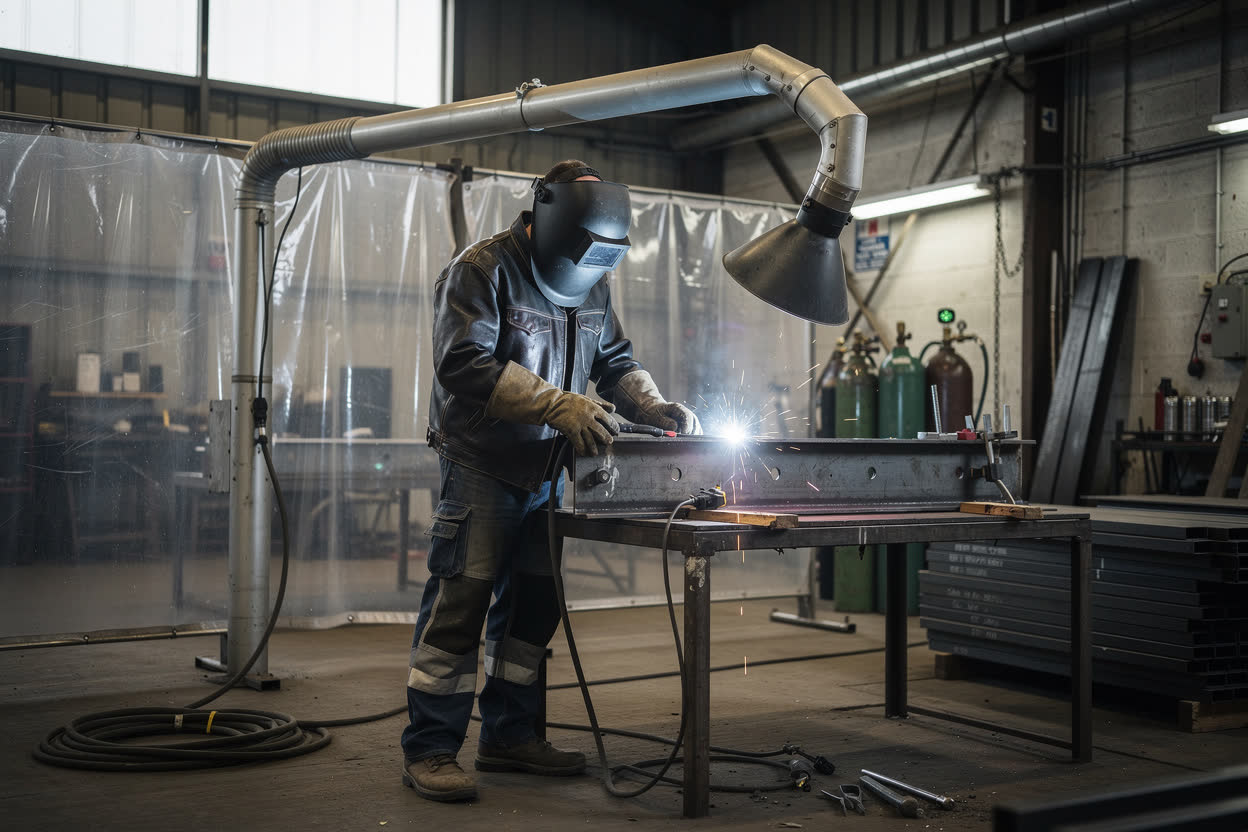
Local exhaust ventilation captures fume at or near the point where it is made, before it reaches your breathing zone. It includes:

  • Extraction built into the welding torch.
  • Moveable capture hoods on flexible arms.
  • Fixed extracted benches and booths.

LEV must be suitable for the work, maintained, and thoroughly examined and tested at least every 14 months under COSHH.

Using LEV Correctly
Using LEV Correctly

LEV only works when it is used properly:

  • Position the hood close to the weld, usually within about one hood diameter, and move it as the work moves.
  • Make sure it is switched on and drawing air before you start.
  • Check the airflow indicator, if one is fitted.
  • Keep your head out of the fume plume.
  • Report any fault, damage or loss of suction straight away.

Welders must be trained to position and use LEV correctly.

Respiratory Protective Equipment

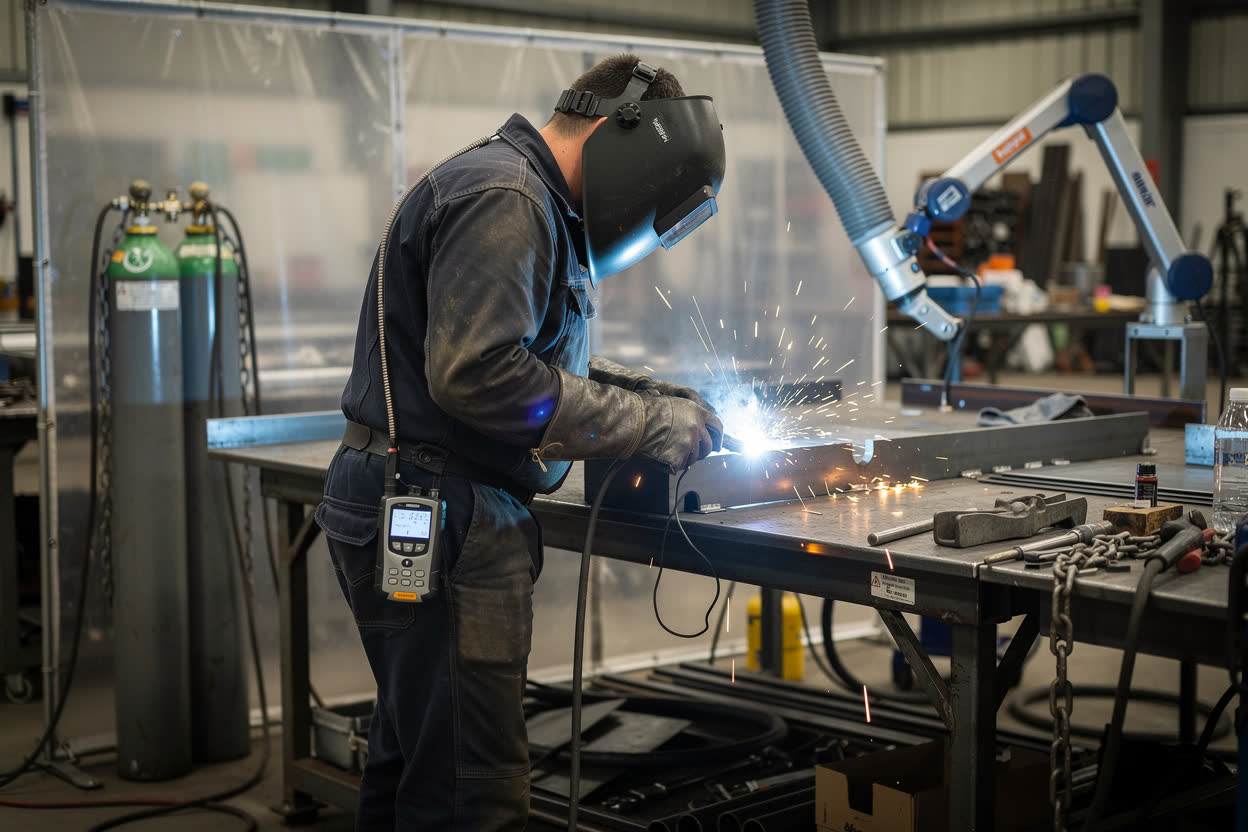
Where LEV cannot control exposure adequately, for example outdoors or in confined spaces, suitable RPE must be worn. A powered air welding helmet is often the best choice.

  • RPE must be adequate for the hazard, and suitable for the wearer and the task.
  • Tight-fitting masks must be face-fit tested for the wearer, and worn clean-shaven.
  • RPE must be checked before use, maintained, and stored correctly.

A simple dust mask is not enough for welding fume.

Health Surveillance
Health Surveillance

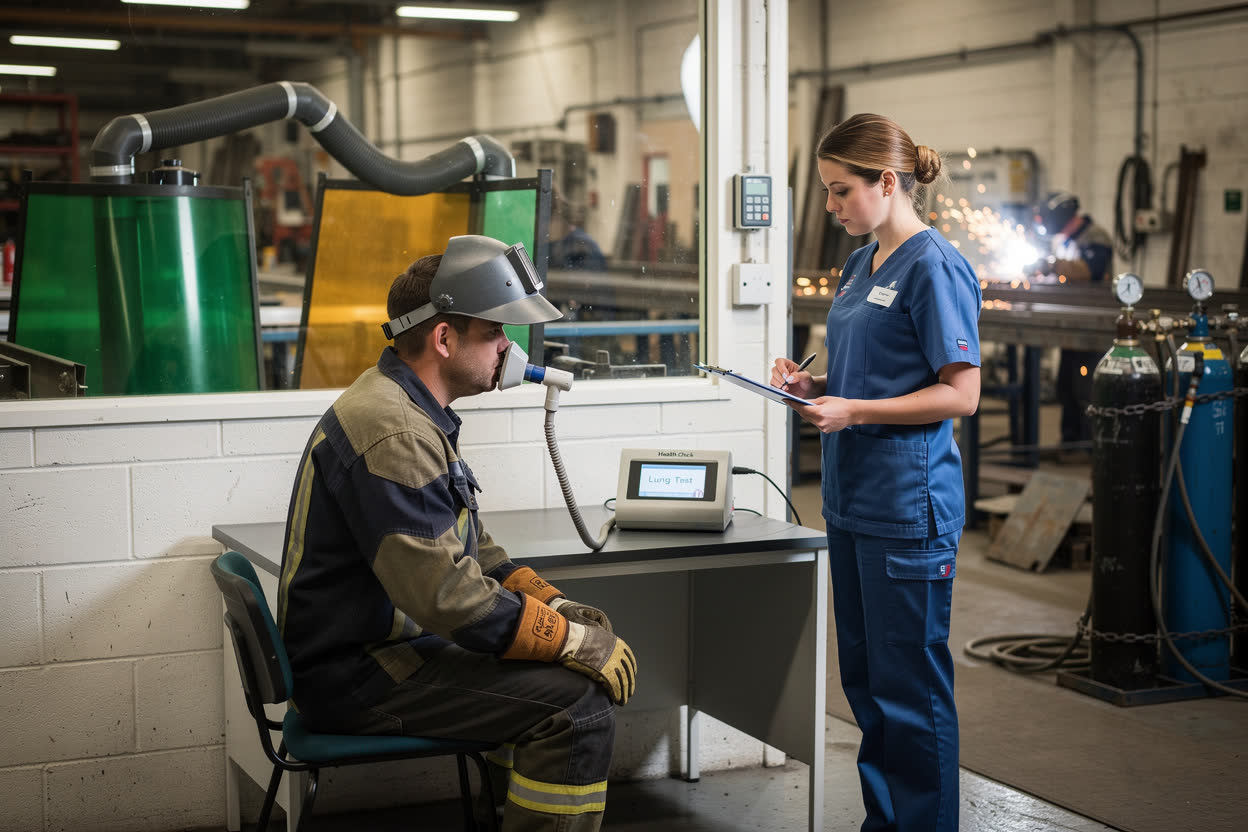
Where welders are exposed to fume that could harm their health, the employer must provide health surveillance. This usually involves lung function testing and questionnaires about breathing symptoms.

Health surveillance picks up early signs of harm, so that action can be taken before serious disease develops. It also shows whether the controls are working. Welders should take part, and report any symptoms honestly.

Summary

In this module, you have learned that:

Welding fume contains toxic metals and gases, and the International Agency for Research on Cancer classifies it as a cause of cancer.

All indoor welding needs suitable exposure control, usually LEV, with RPE where LEV is not enough and for outdoor welding.

Employers must keep exposure below legal limits, and provide health surveillance.

In the next module, we will look at fire, explosion and hot work.

Knowledge Check
Where local exhaust ventilation cannot control the fume, for example when welding outdoors, what must you use?
Select one answer, then press Check.
A fan only
Nothing, the wind will clear it
Sunglasses
Suitable respiratory protective equipment
Correct. Where LEV cannot control the fume, suitable RPE must be worn.
Not quite. Fans and fresh air are not enough to protect your lungs. Try again.
Next Module →Answer the question to unlock the next module.
Page 1 of 16