← Exit
Module 2 · Health and Safety Law and Enforcement0% complete · 13 slides left
Risk Assessment
Risk Assessment
Module 2
This course contains audio. Use headphones in public places.
Introduction
Introduction

In the previous module, you learned that risk assessment is a legal requirement for every workplace and work activity.

This module explains the key legal duties of employers, managers, supervisors and employees under the Health and Safety at Work etc. Act 1974 and related regulations.

You will also learn about the role of the Health and Safety Executive, or HSE, and local authorities, how inspections and enforcement work, and what can happen when safety is not managed properly.


The Main Law
The Main Law

The Health and Safety at Work etc. Act 1974 is the main health and safety law in Great Britain. Northern Ireland has equivalent law, enforced by the Health and Safety Executive for Northern Ireland.

Employers must ensure, so far as is reasonably practicable, the health, safety and welfare at work of their employees. They must also protect other people who may be affected, such as contractors, visitors, customers and members of the public.

What Employers Must Do

The Act and the regulations made under it require employers to:

  • Carry out suitable and sufficient risk assessments.
  • Have a written health and safety policy, where five or more people are employed.
  • Provide information, instruction, training and supervision.
  • Provide safe systems of work, and safe equipment.
  • Consult employees on health and safety.
The Management Regulations

The Management of Health and Safety at Work Regulations 1999 place further duties on employers. These include:

  • Carry out suitable and sufficient risk assessments and, where five or more people are employed, record the significant findings.
  • Keep risk assessments up to date, especially after significant changes, new equipment or processes, or incidents.
  • Provide health surveillance where needed.
  • Give employees information and instruction about hazards and safe procedures, and suitable training.
  • Appoint competent people to help with health and safety.
Duties of Employees
Duties of Employees

Under sections 7 and 8 of the 1974 Act, employees must:

  • Take reasonable care of their own safety and health, and that of anyone affected by what they do.
  • Co-operate with their employer, and follow the controls set out in the risk assessment.
  • Use equipment and protective clothing correctly, as they have been trained.
  • Report hazards, defects and unsafe practices as soon as possible.
  • Never interfere with or misuse anything provided for safety.
Specific Regulations

Specific regulations cover particular hazards and activities, and set out the controls required. Examples in Great Britain include:

  • The Construction (Design and Management) Regulations 2015.
  • The Provision and Use of Work Equipment Regulations 1998.
  • The Control of Substances Hazardous to Health Regulations 2002, known as COSHH.
  • The Control of Asbestos Regulations 2012.
  • The Manual Handling Operations Regulations 1992.
  • The Display Screen Equipment Regulations 1992, and the Confined Spaces Regulations 1997.
  • The Regulatory Reform (Fire Safety) Order 2005.

These do not usually need separate assessments. They can form part of your overall risk assessment.

Guidance and Codes of Practice

The HSE publishes detailed guidance, free of charge, to help employers comply with the law, including:

  • Guidance on the 1974 Act and the regulations made under it.
  • Guidance on carrying out risk assessments.
  • Approved Codes of Practice, or ACOPs, which give practical advice on complying with specific regulations.

An Approved Code of Practice has a special legal status. If you do not follow it, you must show that you complied with the law in some other way that is just as good.

The Health and Safety Executive

The Health and Safety Executive is Great Britain’s national regulator for workplace health and safety. Its aim is to protect people and places, and help everyone lead safer and healthier lives.

In lower-risk premises, such as offices, shops, warehouses, hotels and leisure venues, the law is enforced by local authority environmental health officers.

The HSE does not visit every business every year, and it does not write risk assessments for employers. That is the employer’s job.

Health and Safety Inspectors

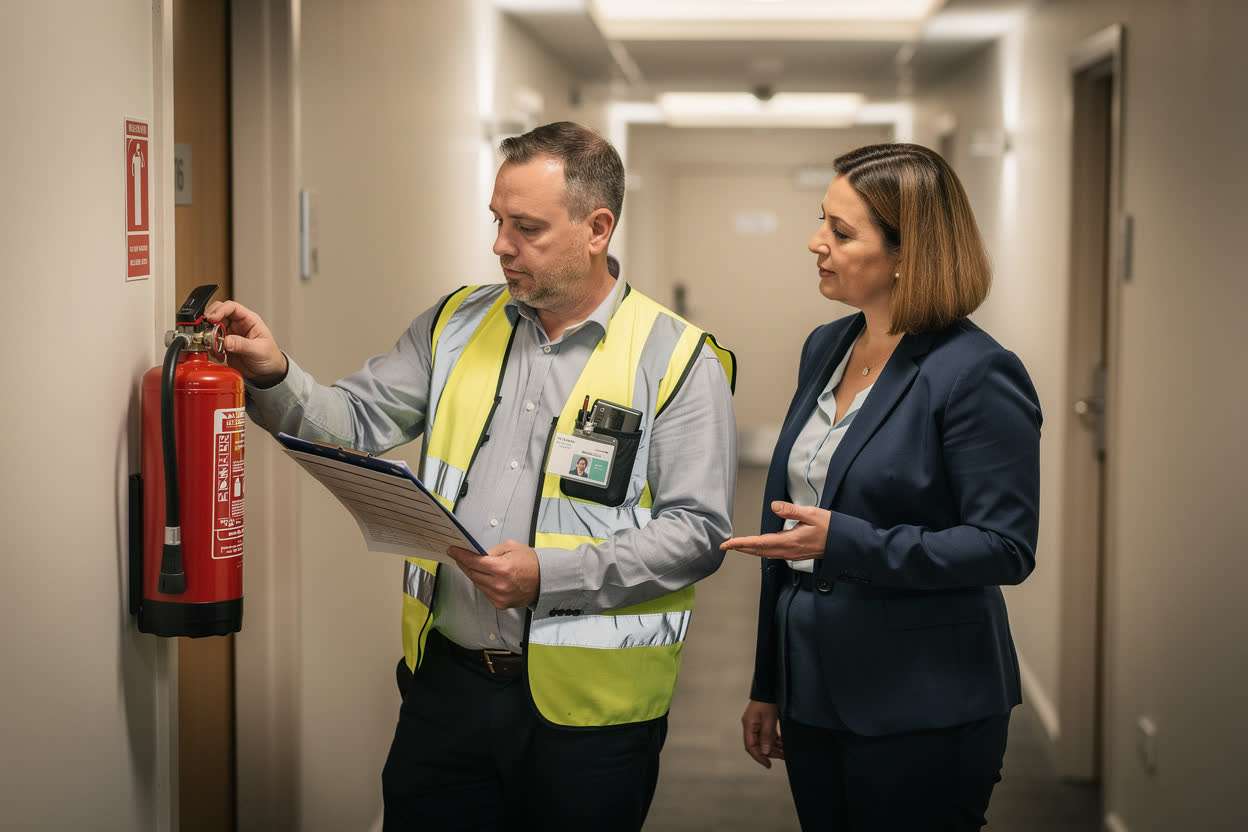
HSE and local authority inspectors can visit workplaces to check working conditions, investigate incidents, and help employers manage risks. Inspections may be routine, or follow an incident, a complaint, or a known risk. Inspectors look for:

  • A suitable, up-to-date risk assessment.
  • Effective control measures in place.
  • Relevant safety procedures and records.
  • Adequate information, instruction and training for employees.

Employers and employees must co-operate with inspectors.

Enforcement Action
Enforcement Action

Where inspectors find breaches of the law, they can take formal action:

  • An Improvement Notice, requiring a problem to be put right within a set time.
  • A Prohibition Notice, where an activity is dangerous. The activity, or the use of equipment, must stop immediately until the risk is controlled.
  • Fee for Intervention, where the HSE recovers the cost of its time from an employer found in material breach of the law.
  • Prosecution through the courts, for serious breaches.
Penalties
Penalties

Failing to comply with health and safety law, or with an enforcement notice, is a criminal offence.

Organisations, and in some cases directors, managers and employees, can be prosecuted. In England and Wales, courts can impose unlimited fines, and some offences carry up to two years in prison.

Beyond the courts, accidents bring human suffering, lost time, higher insurance costs and damage to reputation. Good risk assessment is far cheaper than any of these.

Summary

In this module, you have learned that:

The Health and Safety at Work etc. Act 1974 and the Management Regulations require employers to protect people and assess the risks.

Codes of practice give practical advice and have a special legal status.

HSE and local authority inspectors can issue Improvement and Prohibition Notices, and serious breaches can be prosecuted.

In the next module, we will look at how to carry out an effective risk assessment.

Knowledge Check
What will an inspector issue if a work activity is dangerous and must stop immediately?
Select one answer, then press Check.
An advisory notice
An Improvement Notice
A Prohibition Notice
A prosecution notice
Correct. A Prohibition Notice stops a dangerous activity, or the use of equipment, immediately, until the risk is controlled.
Not quite. An Improvement Notice gives time to put a problem right. When an activity must stop immediately, the inspector issues a Prohibition Notice.
Next Module →Answer the question to unlock the next module.
Page 1 of 14