← Exit
Module 4 · Managing and Using PPE — Part 20% complete · 24 slides left
PPE Course
PPE Course
Module 4
This course contains audio. Use headphones in public places.
Introduction
Introduction

Many work tasks put different parts of the body at risk. Employers must make sure that suitable PPE is chosen and used for the risks that remain after the other, more effective, control measures have been put in place.

This module looks at the PPE used to protect the body from harm: the selection and use of protection for the torso, the arms and hands, and the legs and feet, and high-visibility clothing that keeps the wearer seen.

Work at height is governed by its own legal hierarchy of controls, and personal fall protection, the full body harness and its attachments, sits at the lowest level of that hierarchy. This module gives an overview of the main types of fall protection system, their uses and their limitations. It also covers the PPE for work on or near water, where several tasks carry a risk of drowning.

Finally, the module covers disposable PPE, the health surveillance that some kinds of PPE call for, the maintenance, cleaning, inspection and storage of PPE, and the information, instruction and training that PPE users need, including for emergencies.

Topics to be Covered

The topics covered in this module are:

  • Protection for the body, arms, hands, legs and feet
  • High-visibility clothing
  • Personal fall protection systems
  • PPE for work at or near water, with a case study
  • Disposable PPE
  • Health surveillance for work involving PPE
  • Maintenance, cleaning, repair and storage of PPE
  • Inspection and examination of PPE, and the records to keep
  • Information, instruction, training and emergencies
Protection for the Body
Chemical · heat · cuts · cold · wet
Protection for the Body

Where the more effective controls cannot remove a risk to the torso, arms or legs on their own, body protection may be needed. The risks come from temperature and weather, from equipment that produces sprays and splashes, from contact with machinery, and from hazardous substances.

  • Coveralls, boiler suits and one-piece suits protect ordinary clothing and the skin from dirt, oil and general splashes.
  • Chemical-resistant suits, aprons and sleeves protect against acids, solvents and other hazardous liquids; the material must be chosen for the specific chemical, because no material resists everything.
  • Flame-retardant clothing protects welders, foundry workers and people working near flames or hot metal; ordinary synthetic clothing can melt onto the skin.
  • Cut-resistant and chainmail aprons and vests protect people using knives in food processing and butchery.
  • Thermal clothing protects against cold stores and winter work outdoors; waterproof and breathable clothing protects against rain and wind.
  • Life jackets and buoyancy aids, and harnesses for work at height, are body-worn PPE with their own rules, covered later in this module.

As with all PPE, the clothing must fit, must be compatible with the other PPE worn, and must not itself create a risk, for example loose sleeves near rotating machinery.

Hand and Arm Protection
Cut 388 · chemical 374 · heat 407 · cold 511No gloves near rotating machinery
Hand and Arm Protection

Hands and arms are at risk from machinery, chemicals and other hazardous substances, extremes of temperature, electricity, and knives and other sharp objects. Protective gloves, gauntlets and arm guards are available in a wide range of materials and protection levels, and the marking on each glove shows what it protects against:

  • Mechanical hazards, EN 388: abrasion, blade cut, tearing and puncture, each rated on the glove. But gloves must not be worn near rotating machinery such as drills and lathes, where a glove can be caught and drag the hand in; if there is any risk of entanglement, the work must be arranged so that gloves are not needed.
  • Chemical hazards, EN 374: gloves are tested against specific chemicals, and the code letters on the glove show which. A glove that resists acids may be dissolved by solvents, so the safety data sheet and the glove marking must be matched.
  • Thermal hazards, EN 407: contact heat, radiant heat from a furnace, and small splashes of molten metal. Antistatic gloves are available where there is a risk of fire or explosion.
  • Cold, EN 511: handling frozen goods or working in cold stores.
  • Electrical hazards: insulating gloves, tested and inspected before each use, for work on or near live parts.
  • Biological hazards and micro-organisms: disposable nitrile or latex gloves, changed frequently.

Where gloves are worn for long periods, a separate cotton inner glove helps prevent skin problems. Barrier creams are not a substitute for gloves and must never replace them.

Foot and Leg Protection
S3 boot: toecap + midsole + water-resistantRight size, or it is not worn
Foot and Leg Protection

Foot and leg protection is available for a wide range of tasks:

  • Safety boots, shoes and wellingtons with protective toecaps and penetration-resistant midsoles. Safety footwear can also be oil- and chemical-resistant, antistatic, insulating, or heat-resistant for hot surfaces.
  • Boots that support and protect the ankle, which are preferable to wellingtons wherever conditions allow.
  • Leg guards and knee pads that protect the knee, shin and top of the foot from impact and from kneeling on hard surfaces.
  • Waders for work in shallow water, and chainsaw trousers and chaps that stop the chain on contact.
  • Foundry boots, gaiters and leggings that protect against molten metal splash.

The employer must provide footwear of the right size and shape for each employee; boots that pinch or slip are not worn, or are worn unlaced. Not all safety footwear has a penetration-resistant midsole. If the risk assessment shows a risk from nails, sharp offcuts or broken glass underfoot, the employer must specify footwear that protects the sole, and the supplier can confirm which does.

The standard for most work is EN ISO 20345, and the most common specification is S3: a protective toecap, penetration-resistant midsole, antistatic properties, energy-absorbing heel, and a water-resistant upper with a cleated outsole. S1 footwear has no midsole protection and is for dry indoor use only.

High-Visibility Clothing
EN ISO 20471: Class 1 < 2 < 3Seen by drivers, day and night
High-Visibility Clothing

Every year people are killed and seriously injured because a driver or a plant operator did not see them. High-visibility clothing makes the wearer conspicuous in daylight and in the dark, or wherever they might otherwise go unnoticed, and its purpose is to prevent them being struck by vehicles and moving equipment. It is used on roads, in transport and delivery, in loading bays and yards, in factories and warehouses with forklifts, on construction sites, and in forestry and agriculture.

High-visibility clothing made to EN ISO 20471 is divided into three classes by the area of fluorescent material and retroreflective tape it carries:

  • Class 1: the least conspicuous, for example some trousers and harness-style tabards, for low-risk situations.
  • Class 2: waistcoats, jackets and some trousers, for medium risk.
  • Class 3: the most conspicuous, jackets and coveralls with sleeves, for the highest risk, such as work on or near roads and railways and at night.

Some activities have their own rules on the class required; work on public roads generally needs Class 2 or Class 3. Suppliers can advise on the standard for a given industry, but the employer is responsible for selecting the class that gives adequate visibility in the actual working conditions.

Selecting High-Visibility Clothing
Bright and clean: seenFaded and dirty: replace
Selecting High-Visibility Clothing

When selecting high-visibility clothing, keep the following in mind:

  • Choose the class for the hazard. Where the risk of being struck is low but visibility still matters, a Class 2 waistcoat may be enough; where people work close to moving vehicles, direct traffic, or work at night, Class 3 jackets, and often trousers as well, are needed.
  • Choose it for the conditions. Winter and cold-store work needs thermally lined hi-vis jackets; summer work may need hi-vis waistcoats and lightweight trousers; night work and traffic control need more of the body covered.
  • Make it compatible with the other PPE. Where chemical protection or a harness must be worn as well, the hi-vis clothing must go with them so that the wearer stays both protected and visible; a harness worn over a hi-vis jacket must not hide the reflective bands.
  • Make sure it fits. Oversized clothing catches on moving equipment; undersized clothing is worn open, or not at all.
  • Keep it clean. Dirty or faded hi-vis loses its brightness and its retroreflection, and the employer must provide for cleaning and for replacement when it is worn out; the label gives the maximum number of washes.

Managers and supervisors must make sure hi-vis is worn where required and kept in good condition. Employees must wear it as instructed, keep it clean, store it properly and report damage.

Personal Fall Protection Systems
Restraint: cannot reach the edgeArrest: stops a fall that has startedPlatforms with guardrails come first
Personal Fall Protection Systems

Working at height brings the risk of people falling and of objects falling onto people below. Personal fall protection, the harness and its attachments, sits at the bottom of the legal hierarchy of control for work at height, and it may be used only where more effective measures are not reasonably practicable. Most work at height can and should be done from properly installed platforms with guardrails and toe-boards. There are five types of personal fall protection system:

  • Work positioning systems: a harness and a rope or lanyard that support the worker in position while they work with both hands, for example in tree surgery. The rope moves with the user.
  • Rope access and positioning systems: used by trained specialists to reach parts of tall buildings and structures. The ropes are fixed at both ends and the worker ascends and descends them.
  • Fall arrest systems: a full body harness and a lanyard with an energy absorber, or an inertia reel, connected to an anchor, a running line or a rail. They do not prevent the fall; they stop it, and the forces on the body are limited by the energy absorber. They are common in construction, maintenance and cleaning.
  • Work restraint systems: a full body harness and a short lanyard or running line that physically prevents the user reaching the edge of a roof, a skylight or the edge of a trailer. Because the fall is prevented rather than arrested, restraint is preferred to arrest wherever it can be used.
  • Rescue systems: the equipment and techniques used to reach a person who has fallen or is stranded and bring them down safely.
Essential Considerations for Fall Protection
Check before every use · withdraw after a fallRescue plan before the work starts
Essential Considerations for Fall Protection

Before any fall protection system is chosen, the employer must complete a risk assessment that explains why a working platform, guardrails and toe-boards are not reasonably practicable for the task. The assessment must set out the arrangements for supplying and maintaining the equipment, and for the supervision, training and monitoring of the work. Once fall protection is shown to be necessary:

  • The employer must make sure the right equipment is selected, used and maintained by competent people, and that the anchor points are strong enough and correctly positioned, ideally above the user.
  • The work must be fully supervised by trained managers and supervisors. A harness that is not clipped on gives no protection at all, and nobody knows unless someone is checking.
  • The equipment must be inspected after installation at each location and before first use there, then regularly by a competent person, and after any event that could have affected it, such as a fall, a heavy shock load or severe weather. Inspection records must be kept, and any harness or lanyard that has arrested a fall must be withdrawn.
  • Every user must be trained in the safe use and care of the specific equipment, including the visual pre-use check of the harness, the lanyard, the energy absorber and the connectors before every use, and must be trained again if the equipment changes.
  • A rescue plan must be in place before the work starts. A person left hanging in a harness can lose consciousness within minutes from suspension trauma, so rescue cannot wait for the emergency services.
PPE for Work At or Near Water
Guardrails first, life jacket as wellNever alone over water
PPE for Work At or Near Water

Every year people at work fall into water, and some of them drown. Any task on, over or beside water must be planned carefully, with the most effective precautions put in place first.

Many jobs involve water: work on quays, harbours and boats; bridge, river and canal maintenance; work on tanks, reservoirs and treatment plants; fish farming; and construction beside lakes and rivers. The risk of falling in must be assessed for every one of them.

The simplest and most effective protection is to do the work from a properly supported working area or platform with double guardrails and toe-boards, so that nobody can fall in. Working alone over water should be avoided, and a means of rescue, a lifebuoy, a throw line, a boat, must be to hand.

Personal flotation devices, PFDs, which include buoyancy aids and life jackets, must be considered in the risk assessment for any work at or near water. As always, the more effective precautions come first; the PFD protects the person who has already fallen in, and it must be worn, correctly, before the fall, not fetched afterwards.

Case Study: Work Over Water
No guardrail · no life jacket · alone
Case Study: Work Over Water

This case study shows why the right procedures matter for anyone working on or near water.

The manager of a small passenger-boat business was carrying out winter maintenance on one of the boats. The boat had been on the slipway for the work, but had been put back in the water before it was finished. Working alone, the manager used an improvised raft made of empty oil drums with planks laid across them to reach the hull. The raft had been used before, so the company should have known about it.

Several failures were obvious afterwards:

  • The work should have been completed while the boat was still on the slipway, where there was no risk of falling in.
  • The improvised raft was unstable and had no guardrails.
  • The manager was working alone, which should never happen over water.
  • He was not wearing a life jacket.

There were no witnesses, but it is assumed that he fell from the raft while working on the far side of the boat. The water was close to freezing, and the expert evidence was that cold-water shock could have caused heart failure within moments of immersion. The company was prosecuted by the enforcing authority and fined. Simple precautions, starting with doing the work on the slipway, would have prevented the death; and if work over the water had been unavoidable, a life jacket would probably have kept him afloat long enough to reach the shore a few metres away.

Personal Flotation Devices
50 aid · 100 · 150 · 275 newtons150 N: turns an unconscious wearer face up
Personal Flotation Devices

A thorough risk assessment is essential for work at or near water, including the selection of personal flotation devices. PFDs are made to the EN ISO 12402 series, and the number in the standard is the buoyancy in newtons. There are four main categories:

  • Buoyancy aid 50: for competent swimmers in sheltered water where help is close at hand. It is not a life jacket, will not turn an unconscious person face up, and is rarely suitable for work.
  • Life jacket 100: for sheltered, calm water. It may not support an unconscious person wearing heavy clothing, and may not turn them onto their back.
  • Life jacket 150: for coastal and offshore waters, and the usual choice for most work at or near water. It will turn an unconscious wearer face up in most circumstances.
  • Life jacket 275: for offshore work and extreme conditions, and for wearers of heavy protective clothing or tools that trap air or add weight.

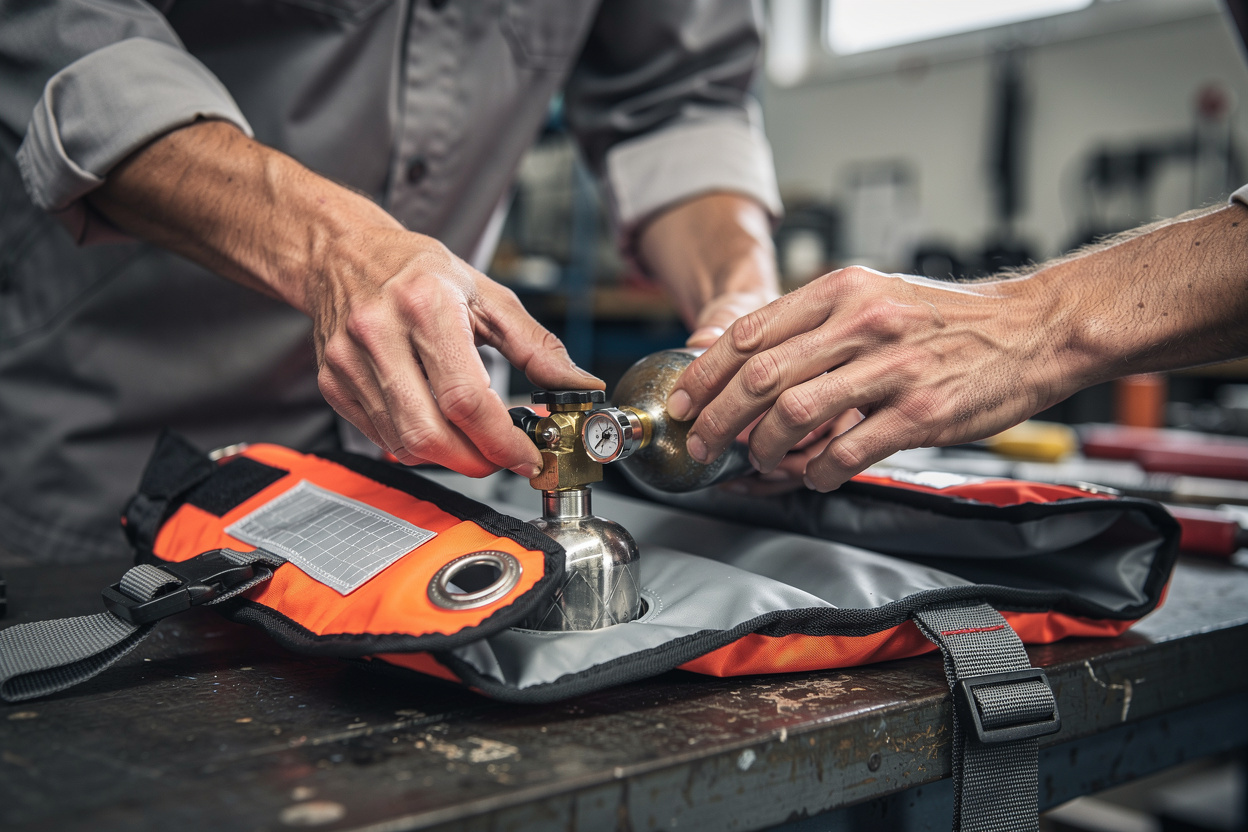
Most work life jackets are inflatable, with a gas cylinder fired automatically on immersion or manually by a pull cord; some are foam-filled. Before any work over or near water begins, the assessment must specify the type of PFD, its buoyancy, and whether automatic inflation is required, and the users must be trained in wearing it, checking it and firing it.

Selecting, Maintaining and Storing PFDs
Cylinder · cartridge · bladder · light · whistle
Selecting, Maintaining and Storing PFDs

Employers must address several points in selecting, providing, maintaining and storing personal flotation devices:

  • Selection must take account of the task, the location, the weather and water conditions, the person doing the work, their swimming ability and weight, and any other PPE or tools they will be carrying, which add weight and may trap air.
  • Most PFDs need regular examination, and inflatable life jackets need periodic servicing by a competent person: the cylinder must be checked for weight and corrosion, the automatic firing cartridge replaced by its expiry date, the bladder inflated and left overnight to check for leaks, and the light and whistle checked. Manufacturers set out the service requirements in the user instructions, and a competent person should review all PFDs in use periodically.
  • Training must cover how to put the PFD on and adjust it, the daily checks before use, how to fire it manually, and how to care for it.
  • Storage must be clean and dry. Damp storage corrodes the cylinder and degrades the fabric, and a PFD left in a vehicle cab in summer heat deteriorates quickly.
  • A PFD that has been inflated must be re-armed by a competent person before it is used again; a used cylinder is an empty one.
Disposable PPE
Single use · fresh each shift · right class
Disposable PPE

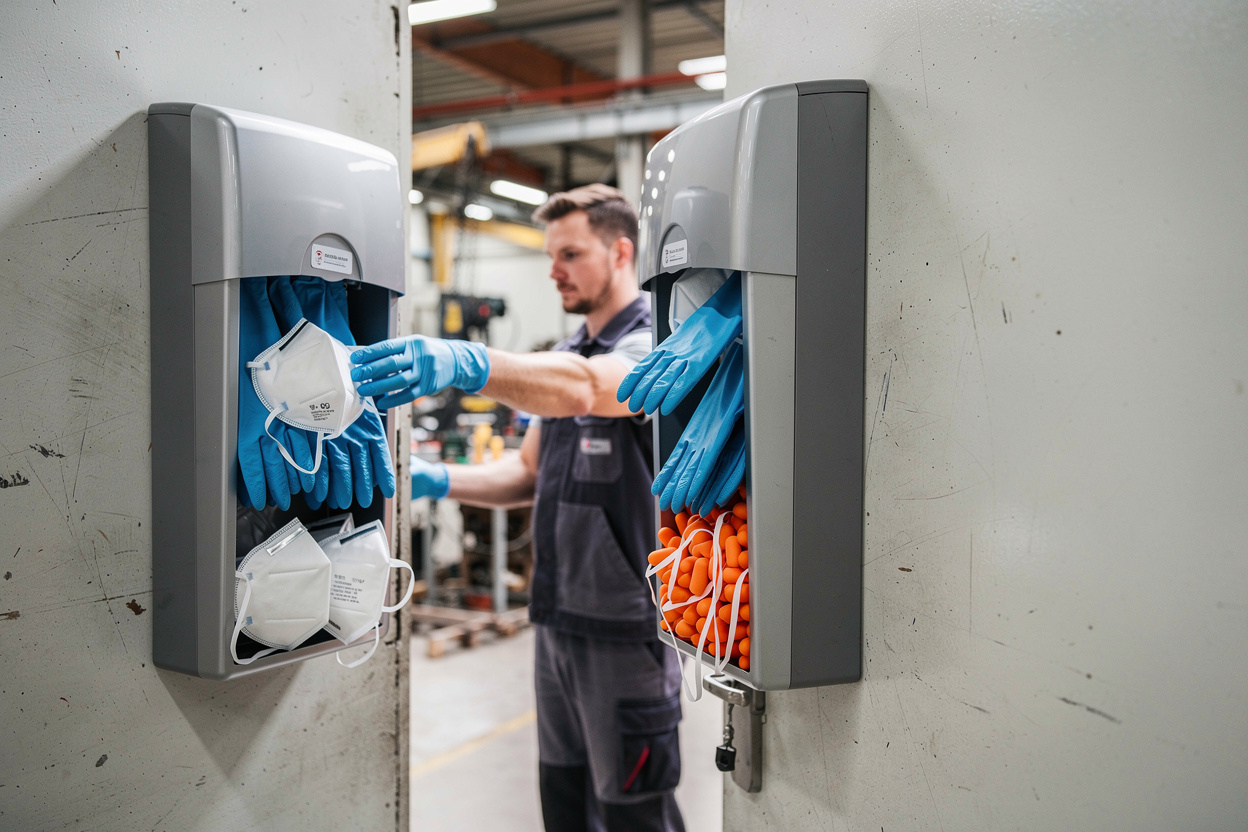
Disposable PPE includes face masks, earplugs, gloves, aprons, overalls and body suits. Employers must make sure that disposable PPE is suitable for the task and adequately controls the risk; disposable does not mean second-rate, but it does mean single use.

Supervisors and managers must check that employees use clean disposable PPE and replace it at the intervals the manufacturer recommends, and that it is right for the conditions: a disposable mask worn in a hot, humid environment becomes damp and stops filtering, and a better solution is needed.

Users must be instructed in the use of disposable PPE and must follow the instructions: clean hands before inserting and removing earplugs; a clean-shaven face and a seal check for disposable masks; a fresh item for each work period and whenever the item is damaged, wet or contaminated. Used disposable PPE must be disposed of safely, and contaminated items, for example gloves used with hazardous chemicals or biological agents, treated as hazardous waste.

The risk assessment must set out the replacement arrangements, and adequate stocks, clean and uncontaminated, must be available at the point of use. Disposable PPE must never replace more effective controls such as local exhaust ventilation, and must never be used where the risk needs a higher level of protection than a disposable item can give; a disposable dust mask comes in FFP1, FFP2 and FFP3, and the class must match the hazard.

Health Surveillance for Work Involving PPE
Does the whole control system work?
Health Surveillance for Work Involving PPE

Health surveillance is a programme of regular health checks, carried out by or under the supervision of a medically qualified person, to make sure that employees' health is not being damaged by their work. Where PPE is being used to control a health risk, health surveillance shows whether the whole system of control, including the PPE, is actually working.

Several sets of regulations require health surveillance where PPE is used to control the risk, including:

  • The Control of Substances Hazardous to Health Regulations 2002 (COSHH).
  • The Control of Lead at Work Regulations 2002.
  • The Control of Noise at Work Regulations 2005.
  • The Control of Vibration at Work Regulations 2005.
  • The Control of Asbestos Regulations 2012.
  • The Ionising Radiations Regulations 2017.

Under these regulations the employer must use the risk assessment to decide whether health surveillance is needed, of what type, and how often.

When Health Surveillance is Required
Disease linked · likely · detectable earlySilica · welding fume · noise · vibration · skin
When Health Surveillance is Required

The employer must decide, for each hazard controlled with PPE, whether health surveillance is required. For hazardous substances it is required where:

  • There is an identifiable disease or adverse health effect linked to exposure to the substance; in most cases the employer will need specialist advice on the health effects, over and above advice on the PPE.
  • There is a reasonable likelihood that the disease or effect may occur under the particular conditions of the work.
  • There are valid techniques for detecting the disease or effect at an early stage, and those techniques pose little risk to the employee.

The risk assessment must consider all three points and build in health surveillance where they are met. Its purposes are:

  • To protect the health of individual employees by detecting ill health early, so that action can be taken before the damage becomes serious.
  • To gather information that helps to evaluate the health risks and confirm whether the controls, including the PPE, are effective.
  • To feed back into the risk assessment, which must be revised if surveillance shows that people are being harmed.

People who may need health surveillance include construction workers exposed to silica dust; welders, woodworkers and metalworkers; laboratory staff working with biological or toxic agents; workers in noisy environments; users of vibrating tools; and anyone whose skin is exposed to substances that cause dermatitis.

How Health Surveillance is Carried Out
Confidential · kept 40 years
How Health Surveillance is Carried Out

Health surveillance is carried out by a doctor, an occupational health physician or an occupational health nurse, and for some hazards by a suitably trained responsible person under their supervision: skin inspections for dermatitis and questionnaires for vibration, for example, can be done by a trained supervisor, with referral to the professional when something is found.

Where the medical adviser recommends it, the employer must act to remove or improve the controls for the work concerned. Employees who show signs of ill health from the work should be given alternative work until the medical adviser has assessed them; the results are also a signal to review the PPE and the way it is being used.

Individual health records from health surveillance are confidential and must be kept for at least 40 years, and they may be disclosed only to the individual concerned or with their consent. The employer keeps a separate health record showing that surveillance has taken place and its outcome in terms of fitness for work.

Employees must be told what the surveillance is for and what it involves, and must attend when it is arranged. They should also be given the anonymised group results, so that they can see whether the controls in their workplace are working.

Maintenance, Cleaning and Repair of PPE
Parts · filters · valves · straps · sealRecords kept 5 years
Maintenance, Cleaning and Repair of PPE

PPE must be maintained, cleaned, inspected, examined and, where appropriate, tested, as the PPE regulations and the regulations for particular hazards require. Every item needs some maintenance, even if it is only cleaning, and the manufacturer's instructions say what is needed and how often.

Respiratory protective equipment needs particular care. Reusable RPE must be examined regularly by a person trained to do it; manufacturers, suppliers and training bodies provide practical training in RPE examination. For complex RPE such as breathing apparatus the supplier or manufacturer may need to be involved; for simpler RPE a trained person in the workplace can do it. Written records of the examinations must be kept, for at least five years.

The regular examination of RPE checks that:

  • All the parts are present, correctly fitted and undamaged.
  • The filters are the right type, in date and in good condition, and the inhalation and exhalation valves are clean and working.
  • The straps, face seal and visor are sound and not perished, cracked or scratched.
  • For powered respirators, the battery holds its charge and the minimum air flow is being delivered to the wearer's breathing zone.
  • For airline and self-contained BA, the hoses, couplings, cylinders and regulators are in good condition and working correctly.

Disposable respirators are not maintained: their use must be monitored so that a fresh one is used for each work period.

Storage of PPE
Clean · dry · close to the workContaminated PPE: sealed bag, never taken home
Storage of PPE

All PPE must be kept in clean, dry storage when it is not in use, and where necessary lockers must be provided. The storage should be at or near the place of work, so that the PPE is to hand when it is needed and goes back when it is not.

There must be a system for taking off and safely cleaning PPE at the end of the work period. Used PPE must be cleaned and stored in a designated changing area, with washing, showering and changing facilities where the work involves hazardous substances, so that contamination is not carried home on ordinary clothes.

Contaminated PPE must be kept in sealed bags and either safely disposed of or cleaned according to the manufacturer's guidance; specialist laundering services can be used for chemical- and asbestos-contaminated clothing. Advice on decontamination should be obtained both from the suppliers of the hazardous substances and from the PPE suppliers.

Supervisors must monitor the use of PPE to make sure it is worn properly and that the storage and decontamination arrangements are followed. Employees play their part by following the instructions, returning PPE to its storage, and reporting any problems or defects.

Inspection and Examination of PPE
RPE: monthly in regular useUser checks every use · expert on schedule
Inspection and Examination of PPE

All PPE must be inspected regularly to confirm that it is still safe to use. The manufacturers' and suppliers' instructions set out the types of inspection and how often they are needed, and managers, supervisors and users must all know what those inspections are. The arrangements for inspecting PPE should be built into the risk assessment for the work in which it is used.

  • Some PPE needs more formal arrangements: RPE, personal fall protection systems, and PPE with moving parts or mechanisms, such as automatically inflating life jackets.
  • For RPE, the HSE advises that RPE in regular use should be examined by a trained, competent person at least monthly, and at least every three months where it is used less often.
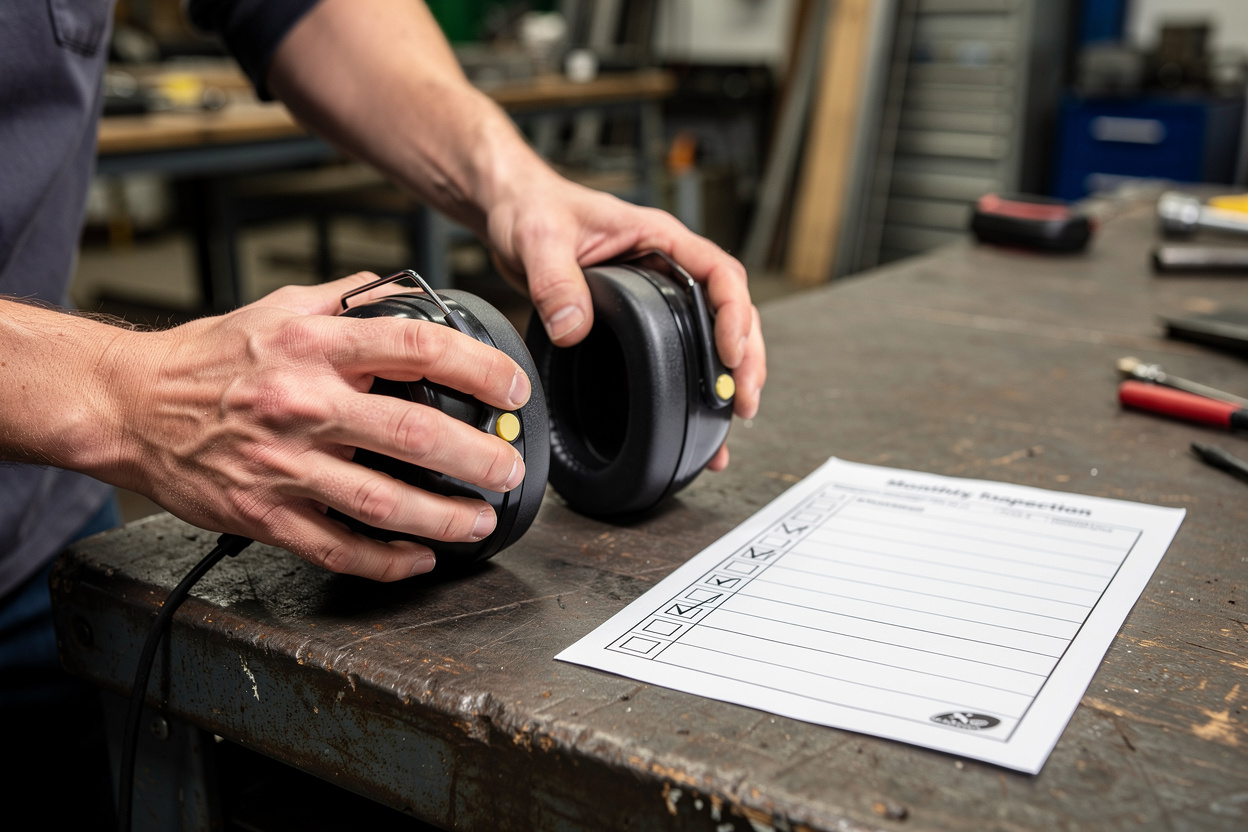
  • Depending on use and conditions, other PPE may need monthly, quarterly or six-monthly inspection. Earmuffs, for example, should be checked monthly by a competent person to confirm they are clean, undamaged, and that the seals and headband are sound.
  • Personal fall protection systems must be inspected by a competent person before first use at a site and at regular intervals afterwards, as well as by the user before every use.
  • Safety helmets, eye protection, gloves and footwear are inspected by the user before each use, and the supervisor checks periodically that this is being done and that worn items are being replaced.
Inspection Records
Who · when · what · defects · action
Inspection Records

Manufacturers and suppliers must include written instructions on the types and frequency of inspection in the information supplied with their PPE, and the employer must keep written records of the formal inspections carried out. A record should include:

  • The name and position of the person making the report.
  • The date and time of the inspection.
  • The name and address of the employer for whom the inspection was carried out.
  • The location of the equipment inspected.
  • A description of the equipment, including its identification number or serial number.
  • Details of any defect or matter identified that could put the health or safety of any person at risk.
  • Details of any action taken as a result of the defect, such as repair, withdrawal or replacement.
  • Details of any further action considered necessary, and by when.

Records prove that the inspection regime is working, show when items are due for replacement, and are the first thing an inspector will ask for after an accident. Keep them for the life of the equipment and for the period the relevant regulations require.

Information, Instruction, Training and Emergencies
Show, practise, refreshEmergency PPE: ready and practised
Information, Instruction, Training and Emergencies

Employers must make sure that the risk assessment and the control measures, including the use of PPE, are explained to everyone involved in the work, including contractors and visitors. Instruction and training must cover:

  • The safe use of the control measures and the safe systems of work.
  • The correct use of the PPE: how to put it on and adjust it, for example an RPE seal check or the fitting of a harness, and how to check it for damage before use.
  • Why the PPE is needed, what it protects against and what its limitations are; people who understand the risk wear the protection.
  • The importance of keeping PPE in good condition and replacing it when it is damaged or worn.
  • The correct cleaning and storage of PPE, including changing RPE filters and cleaning fall arrest equipment.

PPE that needs practical skill, such as RPE, breathing apparatus and fall protection, needs formal training with demonstration and practice, and refresher training at intervals. Manufacturers and suppliers often provide practical training for their equipment.

Emergencies need PPE too: breathing apparatus and escape sets for a gas release, rescue harnesses and descent kits for a fall, life jackets and throw lines for water. The risk assessment must cover the selection, maintenance and regular practice of the PPE used in emergencies, for the people who will respond and for the supervisors who direct them, so that when the emergency comes the equipment is ready and the people know how to use it.

Summary

In this module you have learnt that:

Where more effective controls are not enough on their own, gloves, safety footwear, protective clothing and high-visibility clothing protect the body and limbs. Each is marked with the standard and the hazards it protects against, and the class must match the risk.

Personal fall protection sits at the bottom of the work at height hierarchy and needs strict supervision, training, inspection and a rescue plan; restraint that prevents the fall is preferred to arrest that stops it.

Work over or near water needs guardrails and platforms first, and then a life jacket of the right buoyancy, worn, checked and serviced; never work alone over water.

Disposable PPE is single use and must be the right class. Health surveillance may be needed where PPE controls a health risk, and the employer must decide its type and frequency and act on the results. Every item of PPE needs maintenance, even if only cleaning; RPE and fall protection need formal examination by a competent person, with records kept. Training must be practical, refreshed, and cover the PPE used in emergencies. You have now completed all four modules and are ready for the final assessment.

Knowledge Check
Which of these statements about high-visibility clothing is correct?
Select one answer, then press Check.
The fit does not matter as long as the wearer is visible
Agency and casual workers must provide their own high-visibility clothing
Different classes of high-visibility clothing are chosen for different levels of risk, with Class 3 the most conspicuous
Wet high-visibility clothing can be stored as it is, provided it is clean
Correct — well done. You can continue.
Not quite. Think about what you have just learnt in this module, and try again.
Go to the Test →Answer the question to unlock the test.
Page 1 of 25