← Exit
Module 3 · Managing and Using PPE — Part 10% complete · 22 slides left
PPE Course
PPE Course
Module 3
This course contains audio. Use headphones in public places.
Introduction
Introduction

So far in this course we have looked at what PPE is, the law that applies to it, the hierarchy of control and the risk assessment that decides whether PPE is needed. We have seen that PPE is used only when more effective controls are not reasonably practicable, and that it is used alongside those controls, not instead of them.

Once the assessment has decided that PPE is necessary, the next steps are choosing the right equipment and making sure it is used properly. This module and the next look at the hazards of common work tasks, the risks they pose to different parts of the body, and the types of PPE designed to protect against them.

This module, Part 1, begins with the employer's duty to manage the selection, use and maintenance of PPE, and a case study of what happens when that duty is neglected. It then covers PPE for the eyes and face, the head, the respiratory system, including face-fit testing, and hearing.

Module 4, Part 2, covers protection for the body, arms, hands, legs and feet, high-visibility clothing, personal fall protection, life jackets, disposable PPE, health surveillance, and the maintenance, inspection and storage of PPE.

Topics to be Covered

The topics covered in this module are:

  • The employer's duty to manage the selection, use, maintenance and storage of PPE
  • Case study: what happens when PPE is not managed
  • Risks to the eyes and face, and the types of eye and face protection
  • Risks to the head, and safety helmets
  • Risks to the respiratory system, and the types of respiratory protective equipment
  • Face-fit testing
  • Risks to hearing, the noise regulations, and hearing protection
The Employer's Duty to Manage PPE
Unmanaged PPE is unused PPEPolicy · duties · checks · reporting · storage
The Employer's Duty to Manage PPE

Employers have a clear legal duty to manage the selection, use, maintenance and storage of PPE. This matters because all the evidence shows that PPE is not used properly unless its use is actively managed. If the risk assessment says PPE is needed, managers and supervisors must be committed to making sure it is used, and employees must be told about the hazards, the risks and the protective measures in place. Effective management of PPE includes:

  • Identifying, through the risk assessment, exactly where PPE is needed and what type.
  • Stating in the health and safety policy that PPE must be used where required, that managers and supervisors are responsible for making sure it is, and that employees will be informed and, where necessary, trained.
  • Giving managers and supervisors specific duties and procedures for checking and monitoring PPE use. Some PPE, such as breathing apparatus in a confined space, must be supervised constantly; other PPE, such as respirators and harnesses, needs specialist training.
  • Arrangements for reporting the results of checks and monitoring, so that problems are dealt with quickly.
  • Arrangements for storing, maintaining, repairing and, where necessary, replacing PPE, and making sure they are followed.
Case Study: When PPE is Not Managed
Scratched goggles are not wornBought ≠ provided
Case Study: When PPE is Not Managed

A worker at a metal fabrication company spent most of his shift using an angle grinder to cut and dress steel. Safety goggles and ear defenders were kept in a cupboard in the office, and the risk assessment said they should be worn, but nobody checked. The goggles that were available were badly scratched, so most of the workers used them only occasionally, or not at all.

One afternoon a fragment of a cutting disc struck the worker in the eye. He lost most of the sight in that eye. The investigation found that the company had bought the right PPE but had done nothing to manage it: no supervision, no replacement of damaged goggles, no training, no record of who had been issued with what. The company was prosecuted and fined, and the worker never returned to his trade.

The lessons are the ones this module is about:

  • Buying PPE is not the same as providing it. It must be available at the point of use, in good condition, in the right size.
  • PPE that is scratched, damaged or uncomfortable is not worn, and the employer is responsible for replacing it.
  • Supervisors must check, every day, that PPE is being worn where it is required.
  • Employees must report defects, and must not work without the PPE the assessment requires.
Risks to the Eyes and Face
Impact · dust · splash · heat · light
Risks to the Eyes and Face

Many hazards at work can injure the eyes or the face, and some cause permanent loss of sight. Thousands of eye injuries are reported every year, and almost all of them could have been avoided by the right controls, including eye protection where the assessment calls for it. Examples of hazards to the eyes and face include:

  • Hazardous dusts, gases and liquids released by machines and processes, from fixed machines such as metalworking equipment and from portable equipment such as high-pressure cleaners.
  • Working with powered tools on materials, which throws chips, swarf and fragments towards the face: wood chippings in joinery, sparks and metal particles in grinding, fragments of a bursting cutting disc.
  • Hazardous liquids and chemicals, which can splash onto the face during handling, or when working near someone else who is handling them.
  • Hot metal, sparks, hot liquids and intense light: welding, foundry work, and work with furnaces and ovens expose people to molten metal and radiant heat, and the arc from welding or a laser can damage the eye directly.
  • Wind-blown dust, grit and debris when working outdoors or at height.

Recognising which of these hazards is present is the first step in choosing the right protection, because no single type of eye protection guards against all of them.

Types of Eye and Face Protection
Spectacles: impact onlyGoggles: seal against dust & splashShield: whole face, heat & impact
Types of Eye and Face Protection

The main types of eye and face protection are safety spectacles, safety goggles, and face shields and visors. All must conform to EN 166, and the markings on the frame and lens show the impact rating and the hazards they protect against.

  • Safety spectacles have a metal or plastic frame with impact-resistant lenses, usually with side shields; some have a single moulded lens and frame. They protect against low-energy impact but not against dust, gas or splashes, because they do not seal to the face. They can be made with prescription lenses for people who need glasses and do the work regularly.
  • Safety goggles have a flexible frame with one or two lenses and an elastic headband, and seal all round the face. They protect against impact, dust and splashes. Some are ventilated to reduce misting, and ventilated goggles may not be suitable against gases and fine dusts; unventilated or indirectly ventilated goggles are needed for those.
  • Face shields and visors are a single plastic shield on a headband or clipped to a safety helmet. They protect the whole face against impact, splashes and heat, but they do not fully enclose the eyes, so goggles may be needed underneath them for dust or chemical hazards. Welding shields and helmets have filter lenses of the right shade for the arc.

People who wear prescription glasses can use goggles or face shields designed to fit over them, or prescription safety spectacles. Whatever is chosen must fit and be comfortable, or it will not be worn.

Reading the Markings on Eye Protection
F · B · A = impact energy3 splash · 4 dust · 5 gas · 9 molten metal
Reading the Markings on Eye Protection

Eye protection made to EN 166 carries markings on the lens and on the frame that say exactly what it protects against. Learning to read them takes a minute and prevents the wrong item being issued.

  • Impact rating: S for increased robustness, F for low-energy impact (safety spectacles), B for medium-energy impact (goggles and face shields), and A for high-energy impact (face shields only). Grinding and cutting need at least B.
  • Fields of use: 3 for liquid splashes and droplets, 4 for large dust particles, 5 for gas and fine dust, 8 for electrical short-circuit arc, and 9 for molten metal and hot solids.
  • Extra letters: T means the impact rating is valid at extreme temperatures; K means resistance to surface damage by fine particles; N means resistance to fogging.
  • Welding filters carry a shade number; the right shade depends on the welding process and current, and the supplier's table gives it.

The frame and the lens must both carry the rating; the protection is only as good as the weaker of the two.

Making Eye and Face Protection Effective
Personal · in a case · replaced when scratched
Making Eye and Face Protection Effective

Several points decide whether eye and face protection actually protects:

  • The employer chooses the type of eye protection for the specific task. Specialist suppliers can advise, and manufacturers must provide information on the performance of their products, so the choice can be an informed one.
  • The protection chosen must cover all the risks of the task, not just one of them: impact, dust, splash, misting, molten metal or radiation, as the markings show.
  • It must fit the user and stay securely in place under all working conditions, including for people who wear prescription glasses.
  • Eye protection is personal. Each item is selected for a particular person and should not be shared, for hygiene and for fit.
  • When not in use it must be kept in a case or a suitable container to prevent scratches and contamination; scratched lenses reduce vision and get taken off.
  • Any eye protection that is damaged, badly scratched or has lost its anti-mist coating must be reported and replaced; it is no longer fit for use.
  • Where fixed screens can be fitted, on a bench grinder for example, they should be, but they are an addition to personal eye protection, not a replacement for it.
Risks to the Head
Falling objects · low structures · collisions
Risks to the Head

Head injuries remain common in several industries, and some are fatal or cause lasting damage: skull fractures, brain injury and serious wounds. The first duty of the employer is to prevent the risk altogether, by stopping objects from falling and by removing the low structures that people walk into. Where that is not enough, head protection must be provided and used alongside the other controls. Hazards to the head include:

  • Construction, demolition, mining and quarrying, where materials and tools can fall from height and where structures are being taken apart.
  • Handling materials and goods, where loads can slip from lifting equipment or from racking.
  • Forestry, agriculture and horticulture, where branches, timber and equipment can strike the head.
  • Working around low-level pipework, beams, ducting and vehicle bodies, where the head is struck against fixed objects.
  • Work near overhead electrical conductors, where an insulating helmet may be needed.
  • Work at height, where a falling helmet is itself a hazard to people below unless it is secured with a chin strap.
Head Protection
EN 397 · chin strap at heightReplace after any heavy impactCheck the date in the shell
Head Protection

The main form of head protection is the industrial safety helmet made to EN 397, which protects against falling objects and against striking the head on fixed structures. Some helmets also protect against very low or high temperatures, electrical hazards or molten metal splash; bump caps to EN 812 protect only against knocking the head and are not a substitute where objects can fall. Other work needs other helmets: riding helmets for stable staff, climbing helmets for rope access. Key points for effective head protection:

  • Chin straps: where there is a risk of the helmet falling off, above all during work at height, it must have a chin strap and the strap must be worn and adjusted, so that the helmet does not become a falling object itself.
  • Regular checks: the shell must be checked for cracks, dents and deep scratches, and the harness inside for damage and wear. Users check before use; supervisors check that helmets are in good condition, clean and stored properly. A helmet that has taken a heavy impact must be replaced even if it looks undamaged.
  • Lifespan: helmets deteriorate in sunlight and with age. Most manufacturers specify a life of three to five years from the date of manufacture, which is moulded into the shell; follow the manufacturer's guidance, and replace sweatbands regularly for hygiene.
  • Storage: store helmets out of direct sunlight and away from chemicals, and keep them clean, because a dirty helmet causes skin and hair problems.
  • Compatibility: where earmuffs must be worn with a helmet, use earmuffs that clip onto the helmet, not a separate headband. Never paint a helmet or apply solvent-based stickers; they can weaken the shell.
Risks to the Respiratory System
Dust · fume · vapour · gas · no oxygenInvisible while it develops, often irreversible
Risks to the Respiratory System

The lungs are at risk in many workplaces, from hazardous substances in the air and from atmospheres that lack oxygen. Occupational lung disease still causes thousands of deaths every year in Great Britain, and many more new cases of asthma, chronic bronchitis and other breathing problems are caused or made worse by work. The HSE treats the control of these risks as a priority, and so must every employer.

The next slides look at the hazards, the types of respiratory protective equipment, RPE, available, and why a correct fit is essential. The key points are:

  • Diversity of risk: dusts, fibres, fumes, mists, gases, vapours and oxygen deficiency each need different protection.
  • Scale: work-related lung disease is common, largely invisible while it develops, and often irreversible by the time it is diagnosed.
  • The role of RPE: it protects the wearer's breathing zone, but only when the right type is chosen for the substance and the concentration.
  • Fit: tight-fitting RPE protects only if it seals to the face. An unsealed mask gives a false sense of security and almost no protection.
Hazardous Substances and Oxygen Deficiency
No oxygen = no filter will helpControl at source first
Hazardous Substances and Oxygen Deficiency

Hazardous substances in the air can harm the respiratory system through short-term and long-term exposure. The effects range from irritation to occupational asthma, chronic obstructive pulmonary disease, silicosis, and cancers such as those caused by asbestos, silica and welding fume. Examples of exposure include:

  • Dusts: wood dust in joinery, flour dust in bakeries, silica dust from cutting stone, brick and concrete, and metal dust from grinding.
  • Gases: from cylinders, from processes, and from engines and generators running in enclosed spaces.
  • Vapours and fumes: solvent vapour from paint spraying and cleaning, welding fume, which is classed as a carcinogen, and fumes from hot processes.

Some work environments, confined spaces above all, expose workers to oxygen deficiency and asphyxiation. Air with too little oxygen, or air in which oxygen has been displaced by another gas such as nitrogen, argon or carbon dioxide, causes unconsciousness within moments and death within minutes, and a filtering respirator gives no protection at all against it.

Protection means controlling the substance at source first: enclosure, ventilation, local exhaust extraction and wet methods. RPE is then chosen for the risk that remains, together with air monitoring where needed, and everyone involved must be trained to recognise the hazard and use the protection correctly.

Types of Respiratory Protective Equipment
FFP1 < FFP2 < FFP3Filters: particle, gas/vapour, combinedBA when oxygen may be short
Types of Respiratory Protective Equipment

RPE protects the wearer's respiratory system from hazardous substances and, in the case of breathing apparatus, supplies clean air to breathe. There are two families:

Respirators, which filter the air the wearer breathes:

  • Non-powered respirators: the most common type. The wearer's own breathing draws air through the filter. They include disposable filtering face-pieces to EN 149, classes FFP1, FFP2 and FFP3 in increasing order of protection, and reusable half masks and full-face masks to EN 140 and EN 136, fitted with particle filters (P1 to P3), gas and vapour filters, or combined filters chosen for the substance.
  • Powered respirators: a motor draws air through the filter and delivers it to a mask, hood, helmet or visor. They are more comfortable for long periods, and loose-fitting hoods and helmets can be used by people with beards, because they do not rely on a face seal.

Breathing apparatus, BA, which supplies clean air from an independent source and must be used where oxygen may be deficient or the contaminant is too dangerous or too concentrated for a filter:

  • Self-contained BA, with a cylinder of air carried by the wearer.
  • Airline BA, supplied through a hose from a compressor or cylinder bank outside the hazard area, including air-fed hoods, helmets and visors.

The risk assessment decides the type and the protection factor required. Breathing apparatus must be used only by fully trained people, under competent supervision, with the work area monitored throughout.

Face-Fit Testing
Tight-fitting = fit testedClean shaven at the sealSeal check every time it goes on
Face-Fit Testing

Fit testing is central to the effectiveness of tight-fitting RPE. The aim is to confirm that the face-piece seals to the wearer's face around the breathing zone, the mouth and nose. If the mask does not seal, contaminated air is drawn in around the edges and the protection is largely lost.

  • Loose-fitting powered hoods and helmets do not rely on a seal and do not need fit testing.
  • Tight-fitting respirators, disposable and reusable, and tight-fitting powered masks do rely on a seal and must be fit tested, for each make, model and size of mask the person uses, and again if their face changes through weight loss, dental work or scarring.
  • A qualitative test uses a hood and a bitter or sweet test aerosol: if the wearer can taste it, the mask does not seal. A quantitative test uses an instrument to measure leakage and is required for full-face masks.
  • The wearer must be clean shaven where the mask seals; stubble breaks the seal. Where a beard is worn for religious or other reasons, a loose-fitting powered respirator must be provided instead.

The Approved Codes of Practice for the COSHH, lead, asbestos, confined spaces and ionising radiations regulations all require tight-fitting RPE to be fit tested as part of its selection, and the HSE expects the tester to be competent, for example accredited under the Fit2Fit scheme. The employer must ensure that any failure is acted on and that a record of each test is kept.

Fit testing is a one-off check of the match between mask and face. Every time the mask is put on, the wearer must also do a pre-use seal check, covering the filters and breathing in to feel the mask pull onto the face.

Risks to Hearing
Gradual · permanent · preventable
Risks to Hearing

Noise at work damages health and undermines safety. Exposure to loud noise causes permanent hearing loss and tinnitus, and it also makes people less aware of what is happening around them and less able to hear warnings and alarms.

Every year thousands of cases of hearing damage caused or made worse by work are reported, and because the loss is gradual most people do not notice it until it is severe and irreversible. Noise-induced hearing loss is one of the most common occupational diseases, and one of the most completely preventable.

The next slides look at the activities and workplaces where hazardous noise is common, at the health and safety effects of noise, at what the noise regulations require, and at the types of hearing protection and how to make them effective.

Where Hazardous Noise is Found
Shouting at 2 m? Noise is too loud
Where Hazardous Noise is Found

Hazardous noise is common in many industries and activities, either continuously or in bursts. A useful rule of thumb: if you have to shout to be understood by someone two metres away, the noise is probably above the level at which action is required. Workplaces where high noise levels are common include:

  • Construction, demolition and road works, especially where breakers, cut-off saws, compressors and mobile plant are used.
  • Woodworking shops, metal fabrication, vehicle repair, engineering and bottling plants.
  • Laundries in hospitals and care homes, and industrial kitchens.
  • Agriculture and forestry, where tractors, chainsaws and grain dryers are used, and around livestock.
  • Waste and recycling plants, and printing and packaging.
  • Entertainment venues, call centres with headsets, and any workplace where firearms or explosive tools are used.

Impulsive noise, a single very loud bang from a cartridge tool, a hammer blow on steel or a compressed-air release, can damage hearing instantly, even where the average level over the day is moderate.

The Effects of Noise
Tinnitus · deafness · missed warnings
The Effects of Noise

Health effects:

Repeated exposure to high noise levels causes substantial, irreversible, life-changing hearing damage: a gradual loss of hearing, or in severe cases total deafness. Because the loss is gradual, people rarely notice until the damage is done. Noise-induced hearing loss brings tinnitus, a constant ringing or buzzing in the ears, difficulty in following speech, especially in a crowd, and an inability to enjoy music or conversation. Acoustic shock from a sudden loud noise can cause immediate damage.

Safety effects:

  • Noise prevents workers from communicating with each other.
  • It reduces awareness of the surroundings, for example of an approaching forklift or a reversing vehicle.
  • It causes loss of concentration and fatigue, which make accidents more likely.
  • It masks warning sounds: fire alarms, reversing alarms, shouted warnings and the sound of a machine going wrong.

That is why noise is treated as a safety issue as much as a health issue, and why the choice of hearing protection must never cut the wearer off from the sounds they need to hear.

The Control of Noise at Work Regulations 2005
80 dB(A): available on request85 dB(A): must be worn, zones marked87 dB(A): never exceededNot below 70 dB(A): over-protection
The Control of Noise at Work Regulations 2005

The Control of Noise at Work Regulations 2005 set out what employers must do to control noise. The risk must be reduced to the lowest level reasonably practicable, and hearing protection may only be relied on after the other options in the hierarchy of control have been considered and applied.

To find out whether noise is a problem, employers can use manufacturers' data, compare similar workplaces, consult trade bodies, or, where the levels are hard to estimate, have a competent person carry out a noise assessment. The regulations then set exposure action values, based on daily or weekly personal exposure:

  • Lower exposure action value, 80 dB(A): the employer must assess the risk, provide information and training, and make hearing protection available to any employee who asks for it.
  • Upper exposure action value, 85 dB(A): the employer must reduce the noise by other means so far as reasonably practicable, must provide hearing protection and ensure that it is worn, must mark hearing protection zones with signs, and must provide health surveillance.
  • Exposure limit value, 87 dB(A), taking account of the hearing protection worn: this must never be exceeded. The corresponding peak values are 135, 137 and 140 dB(C).

Hearing protection must reduce the level at the ear to below 85 dB(A), but not below about 70 dB(A): over-protection isolates the wearer and makes it hard to communicate or hear warnings.

Types of Hearing Protection
Earmuffs: seal flat, no gapsEarplugs: clean hands, roll, insert, holdOff for 10 minutes = half the protection
Types of Hearing Protection

There are two main forms of hearing protection, both made to EN 352, and each pack states its attenuation, the amount of noise it removes, so that the employer can match it to the noise measured.

Earmuffs cover both ears completely. A headband keeps the cups pressed against the head, and the seals must sit flat all round with no gaps; glasses arms, long hair and hoods all break the seal. Where a safety helmet is also required, use earmuffs that clip onto the helmet: earmuffs on a separate headband cannot sit correctly under a helmet. Earmuffs are easy to put on and take off, easy for supervisors to see, and suit intermittent noise.

Earplugs are inserted into the ear canal and may be disposable foam or reusable moulded plugs. Reusable plugs need strict hygiene: the wearer must wash their hands before inserting and removing them, or ear infections follow. Earplugs suit people who wear glasses or safety spectacles, or have long hair, better than earmuffs, and they are comfortable in hot conditions. Their weaknesses are that they must be inserted correctly to work, foam plugs must be rolled and held in place while they expand, and they can occasionally push wax against the eardrum, causing temporary hearing loss or infection.

Whichever type is used, hearing protection must be worn for the whole time in the noise. Taking it off for ten minutes in an eight-hour shift can halve the protection it gives.

Making Hearing Protection Effective
Right attenuation · trained · stored · checked
Making Hearing Protection Effective

Hearing protection only works if it is the right protection, worn correctly, all the time. The employer is responsible for:

  • Selecting protection with enough attenuation for the noise levels actually measured, but not so much that the wearer is isolated. The supplier's data and the noise assessment together give the answer.
  • Making sure that everyone who must wear hearing protection is trained in how to fit it, how to check it and when to replace it. A trained supervisor can give this instruction.
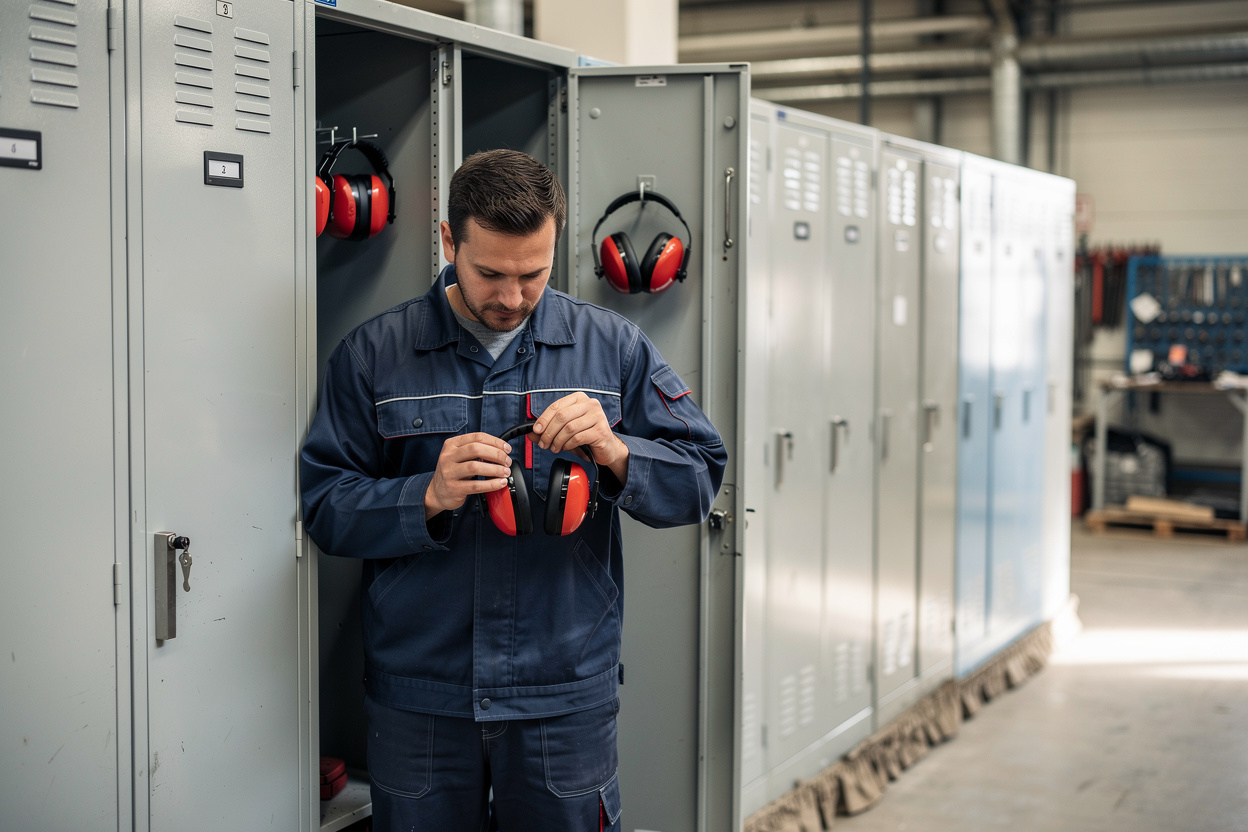
  • Providing proper storage. Earmuffs must be kept clean and away from chemicals and dust, in a locker, a cupboard or at least a sealed container, and never left hanging on machinery, where they get dirty, damaged and lost.
  • Checking earmuffs regularly for worn or hardened seals and weak headbands, and replacing them; the seals are the protection.
  • Supervising and monitoring use, and setting the example: managers who walk through a hearing protection zone without protection tell everyone that it does not matter.

Employees must wear the protection provided, look after it, report damage, and attend health surveillance, the hearing tests that detect early damage while there is still time to act.

Summary

In this module you have learnt that:

Employers must actively manage the selection, use, maintenance and storage of PPE, because PPE that is not managed is not used. Buying it is not the same as providing it.

Eyes and faces are injured by impact, dust, splashes, heat and light. Safety spectacles protect against impact, goggles seal against dust and splashes, and face shields protect the whole face; all must meet EN 166 and be kept unscratched and personal to the wearer.

Safety helmets to EN 397 protect against falling objects and collisions; they need a chin strap at height, regular checks, replacement after impact or at the end of their life, and helmet-mounted earmuffs where both are worn.

Respiratory protective equipment ranges from disposable FFP masks to breathing apparatus, and it must be matched to the substance; tight-fitting masks must be face-fit tested and seal-checked every time. Noise causes permanent hearing loss: hearing protection must be available at 80 dB(A), worn at 85 dB(A), and the ear must never receive more than 87 dB(A). In the next module we look at PPE for the rest of the body, fall protection, life jackets, health surveillance and the care of PPE.

Knowledge Check
At which noise exposure level must an employer make hearing protection available to any employee who asks for it?
Select one answer, then press Check.
70 dB(A)
80 dB(A)
85 dB(A)
90 dB(A)
Correct — well done. You can continue.
Not quite. Think about what you have just learnt in this module, and try again.
Next Module →Answer the question to unlock the next module.
Page 1 of 23