← Exit
Module 5 · Controlling Noise0% complete · 13 slides left
Noise Awareness
Noise Awareness
Module 5
This course contains audio. Use headphones in public places.
Introduction
Introduction

Once a noise risk assessment has shown who is exposed, and to how much, the next step is to reduce the risk. The most effective way to protect hearing is to reduce the noise itself, not just to block it at the ear.

The Control of Noise at Work Regulations 2005 require employers to eliminate noise risks at source or, where this is not reasonably practicable, reduce them to as low a level as is reasonably practicable. This module explains how.


In This Module
In This Module

By the end of this module, you will be able to:

  • Describe the hierarchy of control for noise.
  • Explain how elimination, substitution and buying quiet reduce noise.
  • Give examples of engineering and organisational controls.
  • Explain why maintenance keeps noise down.
  • Describe what is required at the upper exposure action value.
The Hierarchy of Control

Noise controls should be considered in this order, starting with the most effective:

  • Eliminate the noisy process or equipment altogether.
  • Substitute quieter equipment, materials or methods.
  • Use engineering controls, which reduce noise at source or along its path.
  • Use organisational controls, which reduce who is exposed and for how long.
  • Use hearing protection, as the last resort, alongside the other controls and never instead of them.
Elimination
Elimination

The best solution is to remove the noise completely. For example:

  • Doing the task a different way, so the noisy step is no longer needed.
  • Buying in parts already cut to size, instead of cutting them on site.
  • Moving a noisy process to a separate building or area, well away from people.
  • Using remote controls, so operators can work from a quiet room.
Substitution
Substitution

Where noise cannot be removed, substitute a quieter option. For example:

  • A quieter machine, or a tool designed for low noise.
  • Pressing instead of hammering, or welding instead of riveting.
  • Rubber or plastic linings in chutes, hoppers and bins, so materials do not crash onto bare metal.
  • Slower, smoother processes that create fewer impacts.
Buy Quiet
Buy Quiet

Many noise problems are created when equipment is bought. A buy-quiet policy means noise is considered every time machinery, tools or vehicles are bought or hired.

Manufacturers and suppliers must give information on the noise their machines make. Compare this information, ask about quieter models and noise-reducing options, and choose the quietest equipment that will do the job. Buying quiet costs little. Fixing a noisy machine later costs far more.

Engineering Controls

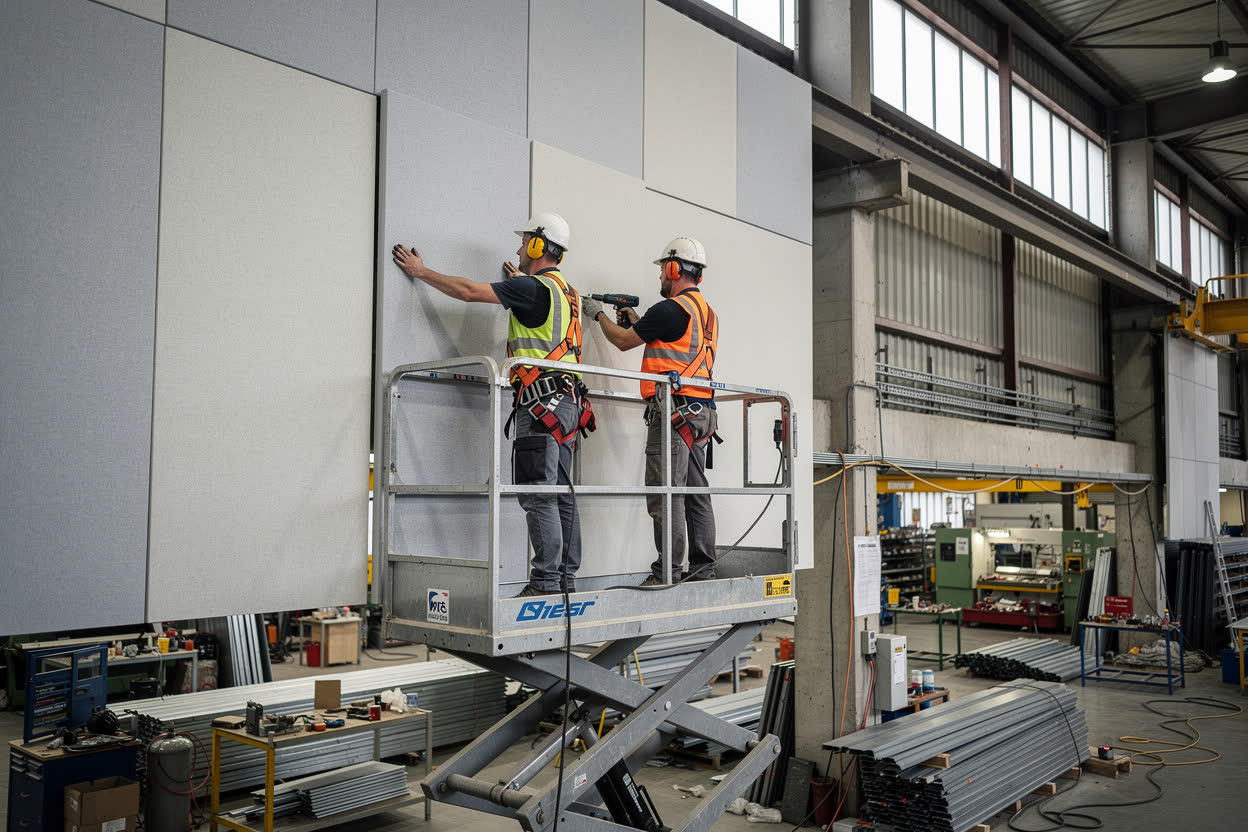
Engineering controls reduce noise at source, or stop it travelling. Examples include:

  • Enclosures: acoustic covers or booths around noisy machines.
  • Barriers and screens that block the direct path of noise to workers.
  • Damping material on panels and guards, to stop them vibrating and ringing.
  • Anti-vibration mounts, so machines do not shake floors and structures.
  • Silencers on exhausts, air outlets and compressed-air lines.
  • Sound-absorbing panels on walls and ceilings, to reduce echo.
Keeping Controls Working

Noise often rises as equipment wears. Loose panels, worn bearings, blunt blades, poor lubrication and compressed-air leaks all make machines louder. Regular, planned maintenance keeps noise down.

Noise controls need looking after too. Keep enclosure doors and covers closed, repair seals and damping, and replace damaged silencers. Report any increase in noise, or any damaged control, straight away.

Organisational Controls

Organisational controls reduce how many people are exposed, and for how long:

  • Plan the layout so noisy machines are away from other work areas.
  • Increase the distance between people and noise sources.
  • Limit the time each person spends in noisy areas or on noisy tasks.
  • Rotate jobs, so that no one person’s daily exposure is too high.
  • Provide quiet areas for breaks, rest and paperwork.
  • Schedule noisy work for times when fewer people are present.
A Noise Control Programme

Where anyone is likely to be exposed at or above the upper exposure action value of 85 dB(A), or a peak of 137 dB(C), the employer must reduce exposure to as low a level as is reasonably practicable, through a programme of organisational and technical measures.

Providing hearing protection does not count as part of this programme. It should set out what will be done, by whom and by when.

If the Limit Value Is Exceeded

The exposure limit value of 87 dB(A), allowing for hearing protection, must never be exceeded. If it is, the employer must:

  • Take immediate action to bring exposure below the limit.
  • Find out why the limit was exceeded.
  • Change the controls and protection, so that it cannot happen again.
Summary

In this module, you have learned that:

Noise is controlled by following the hierarchy: eliminate, substitute, engineering controls, organisational controls, and hearing protection last.

Enclosures, silencers, damping and good maintenance reduce noise at source. Layout, distance and limiting time reduce exposure.

At the upper exposure action value, a programme of technical and organisational measures must reduce exposure. Hearing protection alone is not enough.

In the next module, we will look at hearing protection, health surveillance, and everyone’s responsibilities.

Knowledge Check
Which of these should an employer consider first when controlling noise?
Select one answer, then press Check.
Eliminating the noise, or substituting quieter equipment
Issuing ear defenders to everyone
Putting up warning signs
Telling workers to take more breaks
Correct. Elimination and substitution come first in the hierarchy of control. Hearing protection is the last resort.
Not quite. Think about the hierarchy of control, and which step is most effective. Try again.
Next Module →Answer the question to unlock the next module.
Page 1 of 14