Lesson Objectives
This lesson covers:
- The four areas you should consider before you carry out a manual handling task.

This lesson covers:
Your employer will carry out a risk assessment of any manual handling task that is done on a regular basis. But if you want to avoid injury, now and in the future, you need to develop the habit of assessing the risk in every handling task you take on yourself. That matters even more if you only handle loads occasionally, because the habit has never had a chance to form.
There are four areas you should assess before you carry out a manual handling task. Many people find it helpful to remember the word TILE. T for the task. I for the individual, that is you. L for the load. And E for the environment you are working in. We will now look at each of these four in more detail.
Sometimes the task itself gets overlooked. People tend to assess the load, because a load is visible and you can put your hands on it. The task is just a habit, so it goes unquestioned. But how a task is carried out is exactly what tells you how to reduce the risk. Looking properly at a task may show that the load could be lifted mechanically, and that no one needs to handle it at all. Remember, the best way to avoid injury is to avoid lifting altogether.
Even when a task cannot be automated, there are still things you can do. Think about someone who carries a bag of documents to work every day. Could the number of documents in the bag be reduced? Or could there be a second set, so one stays at work and one stays at home?
Keeping a second set of documents, one at work and one at home, is the better answer. It removes the need to carry anything at all. Get into the habit of looking at every task this way, and find what works for you.
If you cannot remove the handling entirely, the next priority is to reduce the risk. A task that involves twisting, stooping or stretching carries a higher risk, because each of those movements puts extra stress on the body. We will now look at the common risk factors in a task, and at what you can do about each one.
Bending over puts far greater strain on the lower back, and it raises the risk of injury. When your spine is bent over, the whole structure of your back is under load at once. So look at the task and find a way to bring the work up to you, instead of taking yourself down to it.
Awkward movements such as stretching raise the risk of injury. To reduce stretching, avoid lifting from shoulder height, especially when the load is heavy. Heavy items belong at waist height, where they can be handled comfortably. The risk goes up whenever the load sits below mid thigh height, or above shoulder level.
Twisting acts on the lower back and puts stress through the whole structure of your spine. Do not twist your body while you are carrying a load or placing one down. Turn your feet and turn your whole body in the direction you want to go. And avoid any sudden, jerky or hard to control movement.
Always consider a mechanical aid to take the strain out of a carry. Something as simple as a sack trolley lets you move a load easily. A pallet truck, a sack trolley, a clothes rail or a conveyor belt all let the equipment do the work instead of your back. One important point. Never use a mechanical aid you are unsure about, or that you have not been trained to use.
If you have the choice, push rather than pull. Check first that there are no hazards or obstructions along your path. And you must be wearing slip resistant footwear whenever you push or pull a load.
Try to avoid repetitive handling, because it works the same muscles over and over with no recovery. Where this happens, rotate or vary the task. Varying the task lets some muscles rest while others take over. If you cannot vary the task, then you must allow enough rest and recovery time.
Let us check what you have learned so far. There are four areas to assess for risk in manual handling. Task, individual, load and environment. That is true. A handling task should be examined first to see whether the handling can be removed altogether, and if it cannot, to find ways of reducing the risk. That is also true. Tasks that involve twisting, stooping or stretching carry a higher risk of injury. True again. And the last one. It is better to twist your body when lifting or carrying, instead of turning your feet and body in the direction you want to go. That one is false. Always move your feet.
The individual capability of the person doing the task has to be considered. Age, general health and fitness all affect what a person can lift. Never make a lift when you are unsure about your own capability. Lift only what you can handle comfortably. And because people differ so much, it is difficult to set one exact maximum weight that applies to everyone.
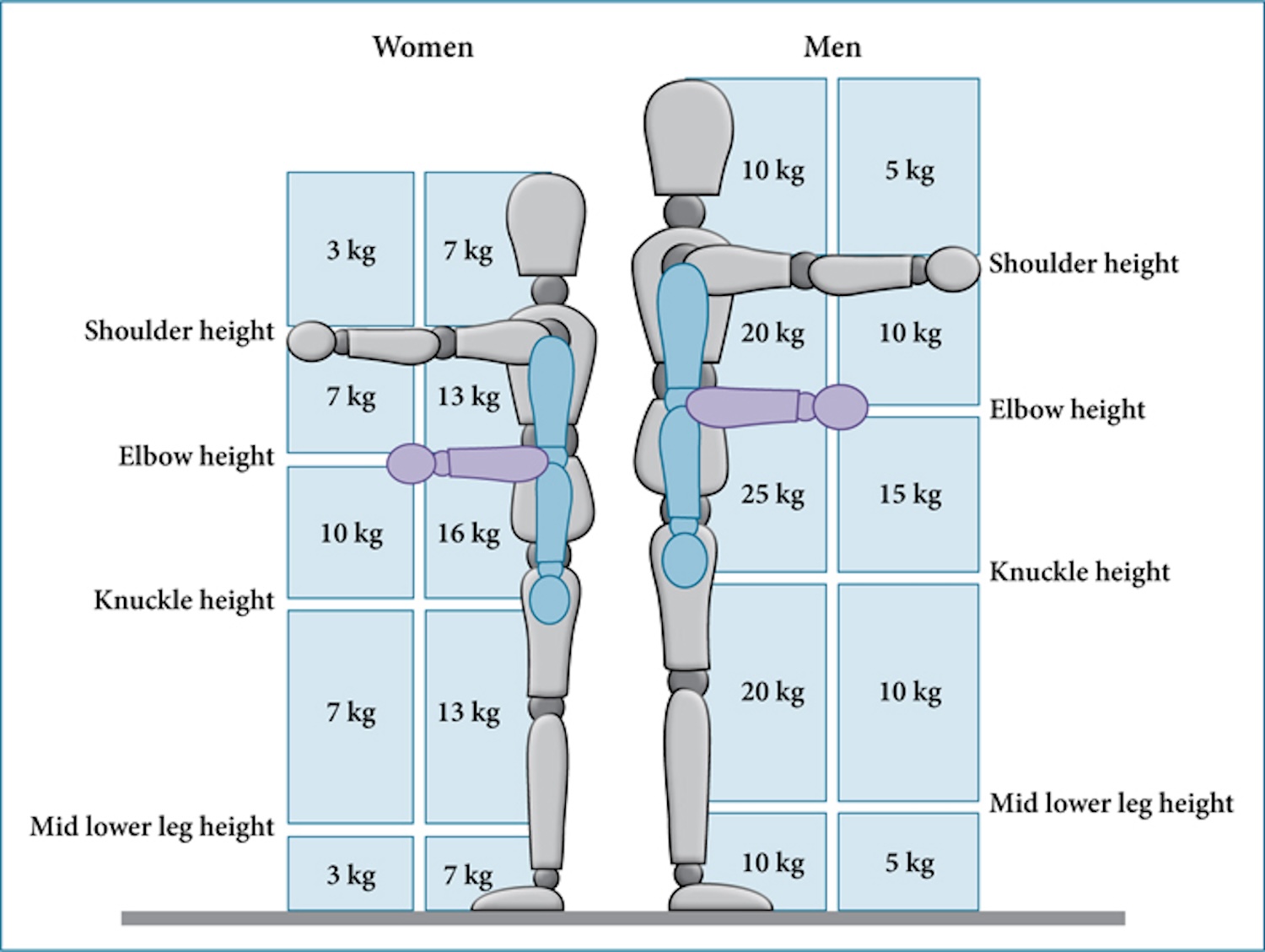
Take a moment to study the image. It gives the guideline weights for lifting at different positions of the body. Notice how the figure drops as the load moves away from your waist, and how it drops again at full arm's length. Use these guidelines to decide whether a particular load is one you should be lifting at all.
If you have a particular health issue, such as an existing back injury, or if you are taking any medication that could affect your handling capacity, you should tell your manager. Never make a lift you are unsure about. And tell your manager if you need specialist training.
In general, wear flat shoes with non slip soles. If you are pushing or pulling a load, the footwear must be slip resistant. And where there is a risk of injury to the foot, suitable shoes or boots must be provided for you.
To prevent back pain, keep fit and exercise. Weak muscles are very often the cause of back pain in the first place. The muscles of the back, the abdomen and the buttocks all support the spine. These are your core muscles, and strengthening them lowers your risk of back pain. Strong quadriceps and hamstrings matter too. If your legs are weak, you will end up lifting with your back instead. Ask your doctor which exercises are right for you.
You should always check the weight of a load before you lift it. Sometimes the weight is clearly marked. But when it is not marked, or the load is unfamiliar to you, there are a few simple techniques you can use to judge it.
One technique is to rock the load backwards and forwards. While you do that, check whether there is a heavy side, in other words whether the centre of gravity sits off centre. You can also apply force to the load gradually, and stop straight away if the strain feels uncomfortable.
Besides the weight, examine the load itself. Is it bulky, or hard to get hold of? Does it have sharp or torn edges? Is it hot, wet, dirty or slippery? Is there information displayed on it? Is it unstable, with contents that shift as you move? And will it block your view as you carry it?
Once you have assessed the task and the load, assess the space you are working in. Before you move anything, ask yourself. Is there enough room to manoeuvre comfortably? Are the floors even, stable and on one level? Is the temperature comfortable, because extremes of heat or cold make a load harder to grip. And is there enough light to see clearly what you are doing?
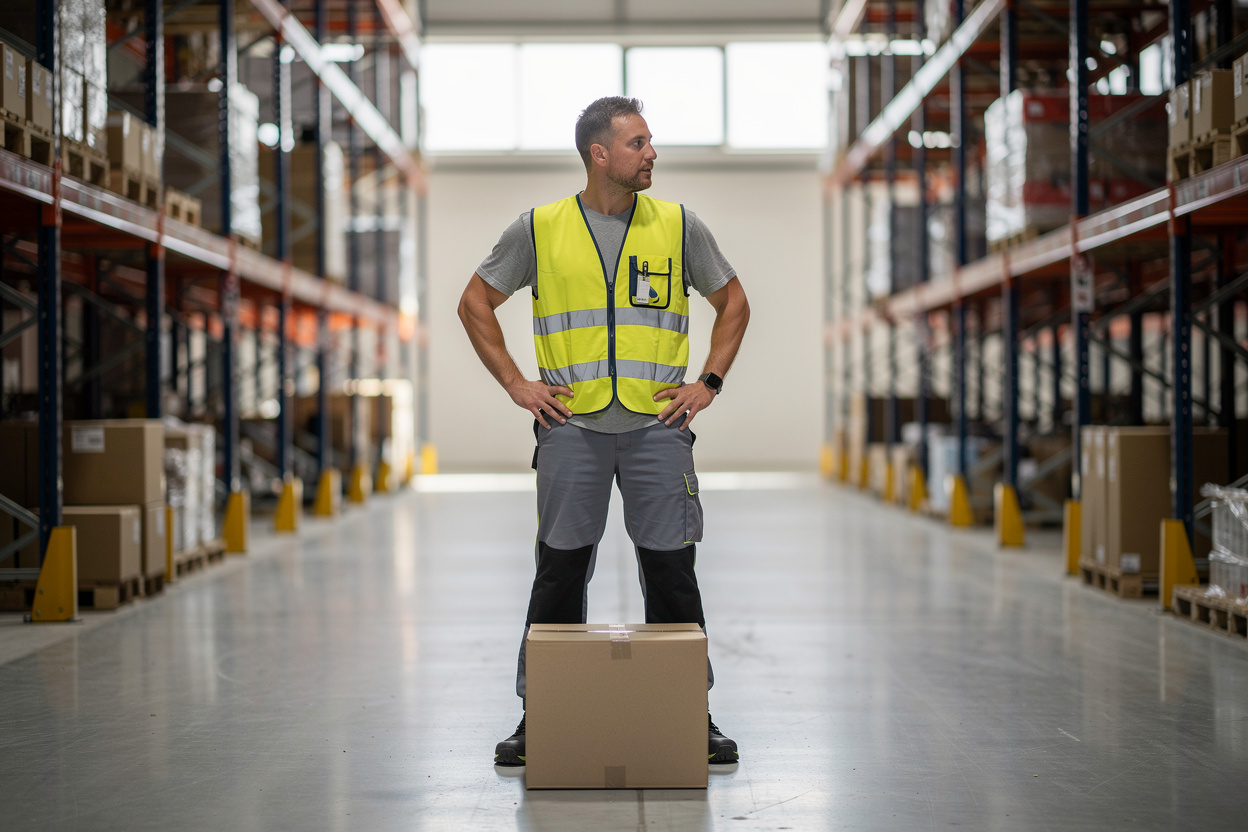
Bad handling habits can go unnoticed for years. You may feel nothing at all today, and still be facing a real back injury later on.

So it is in your own interest to assess every handling task you carry out.

When you assess one, think TILE. The task. The individual, meaning your own capability on that day. The load. And your working environment.