← Exit
Module 2 · Legal Responsibilities0% complete · 20 slides left
Ladder Safety
Ladder Safety
Module 2
This course contains audio. Use headphones in public places.
Introduction
Introduction

This module explains where the legal duties for ladder work come from, and who carries them. You will learn about:

  • What employers must do.
  • The BS EN 131 standard for ladders and stepladders.
  • The specific legal requirements for ladders.
  • What employees must do.
  • Recording and reporting accidents.
  • The role of the Health and Safety Executive, or HSE, and local authorities.
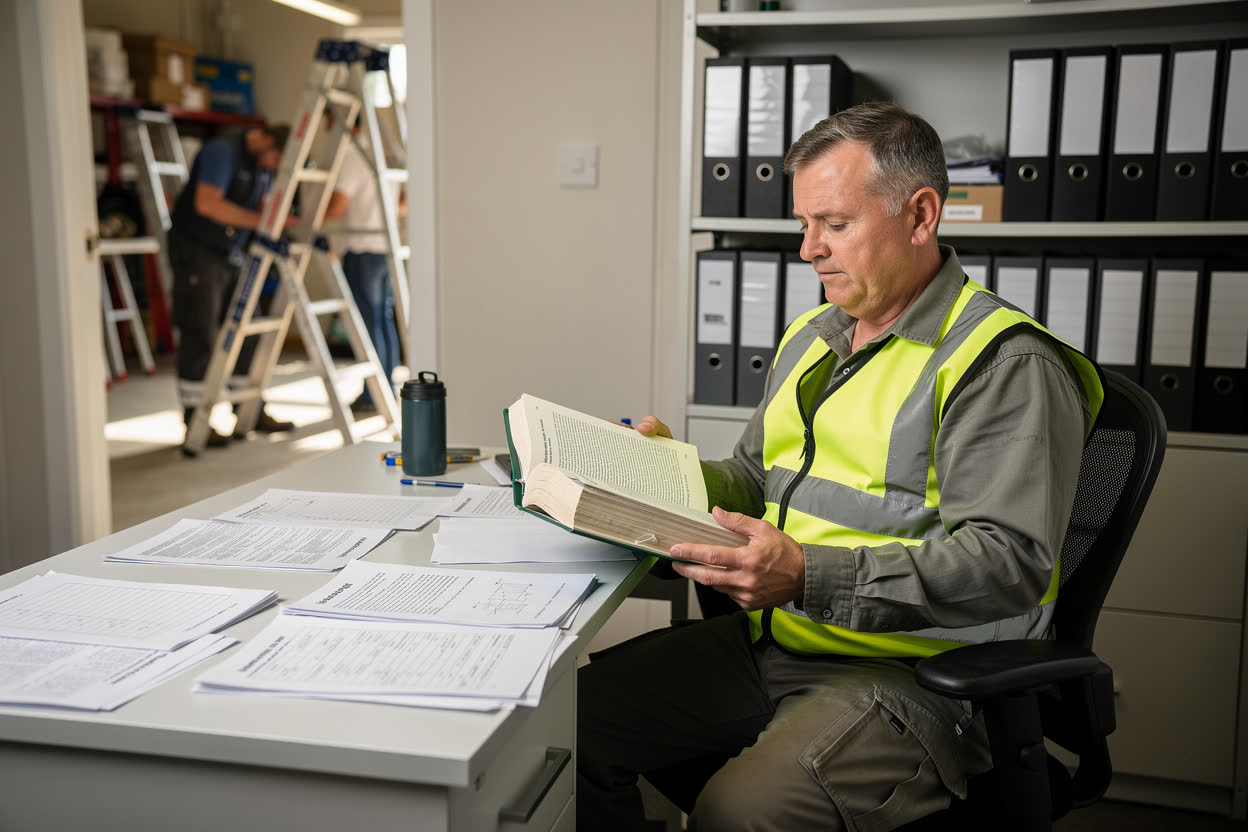
Work at Height Law in the UK

In the UK, the main laws that apply to ladder work are:

  • The Health and Safety at Work etc. Act 1974, which sets out the general duties of employers and employees.
  • The Work at Height Regulations 2005, which control all work at height, including the use of ladders.
  • The Management of Health and Safety at Work Regulations 1999, which require risk assessment.
  • The Provision and Use of Work Equipment Regulations 1998, which cover ladders as work equipment.
The Hierarchy for Work at Height

The law sets a clear order of priorities for work at height:

  • First, avoid work at height altogether, where it is reasonably practicable. For example, clean windows with a water-fed pole from the ground.
  • Where it cannot be avoided, prevent falls by using an existing safe place of work, or equipment such as scaffolds, towers and platforms with guardrails.
  • Where the risk of a fall remains, minimise the distance and consequences of a fall, for example with nets or fall arrest equipment.

A ladder comes into the picture only when a risk assessment shows it is a sensible choice.

The General Duties of Employers

Every employer must, so far as is reasonably practicable:

  • Provide a safe workplace and safe systems of work.
  • Supervise people, so that safe systems are understood and followed.
  • Carry out suitable and sufficient risk assessments, including for ladder work, and record the significant findings.
  • Plan, organise, monitor and review the preventive and protective measures.
  • Tell employees about the risks they face and the controls in place.
  • Provide the training needed to make employees competent.
  • Provide safe access to, around and out of the workplace.
Employer Duties for Work at Height

When work at height cannot be avoided, employers must also make sure that:

  • The work is properly planned, appropriately supervised and carried out safely.
  • Everyone involved is competent, or is being trained under the supervision of a competent person.
  • The equipment chosen is the equipment the risk assessment showed to be suitable.
  • Weather conditions are taken into account.
  • Equipment is properly inspected and maintained.

Employers should also know the Work at Height Regulations 2005, and the HSE guidance that goes with them.

Buying Ladders to BS EN 131

Portable ladders and stepladders must meet the European standard EN 131, published in the UK as BS EN 131. The standard was revised to make ladders wider, stronger and more stable. The old British standards, BS 2037 and BS 1129, have been withdrawn.

  • A ladder for work must be the Professional class. The Non-professional class is for use at home only.
  • A new ladder should be marked with the standard and its class on its label.
  • Older ladders in good condition may stay in use, but any replacement must meet the current standard.

A missing or unreadable label is a reason to question the ladder.

Checking a New Ladder When It Arrives
A new ladder should come with a supplier's certificate confirming the standard.A CE mark is not required on ladders and is no substitute for the standard's own marking.Buyers should check the certificate, the marking and the class every time.
Checking a New Ladder When It Arrives

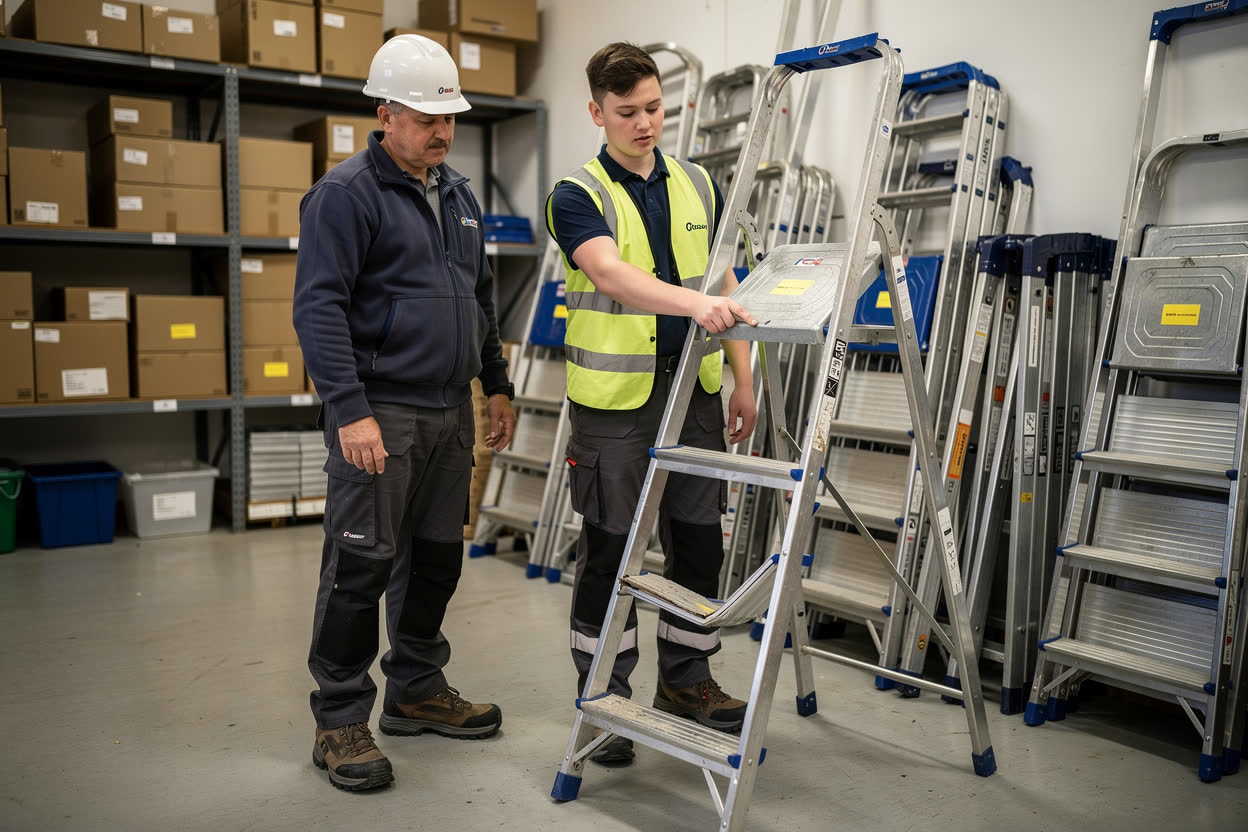
Buying the right ladder is the first control, so employers and buyers should check every new ladder or stepladder when it arrives. As well as the BS EN 131 marking and the class on its label, it should come with a supplier's certificate confirming that it meets the standard. A CE mark is not required on ladders and stepladders, so do not treat one as proof of anything; it is no substitute for the standard's own marking.

The older British standards, BS 2037 and BS 1129, may no longer be used for making or selling new ladders, so a new ladder offered only against those standards should be refused. Check the certificate, the marking and the class for every purchase, and keep the certificate with the ladder's inspection records.

Ladder Classes, Load and Testing

Under EN 131, both classes of ladder have the same maximum total load: 150 kilograms. That figure includes the user, their clothing, their tools and anything else taken up the ladder.

What separates the classes is durability. A Professional ladder must pass tougher tests, because trade use is much harder on equipment.

  • A leaning ladder that is three metres or longer must have a wider base, usually a stabiliser bar, to make it less likely to slip or tip.
  • Durability testing is stricter than under the old standard.
Knowledge Check
What is the maximum total load, including the user and their tools, for a ladder made to EN 131?
Select one answer, then press Check.
100 kilograms
175 kilograms
150 kilograms
200 kilograms
Correct. The maximum total load is 150 kilograms, and that includes the user, tools and materials.
Not quite. Remember that the user and everything they carry count towards the limit. Try again.
The Legal Requirements for Ladders: 1 to 3

Schedule 6 of the Work at Height Regulations 2005 sets out specific requirements for ladders. The first three are:

  • A ladder may be used for work at height only where a risk assessment shows that more suitable equipment is not justified, because the risk is low and the use is short, or because of features of the site that cannot be changed.
  • The surface a ladder stands on must be stable, firm, strong enough, and keep the rungs or steps level.
  • A ladder must be positioned so that it stays stable during use.
The Legal Requirements for Ladders: 4 to 7
  • A suspended ladder must be attached securely, so that it cannot be displaced or swing. Only a flexible ladder is an exception.
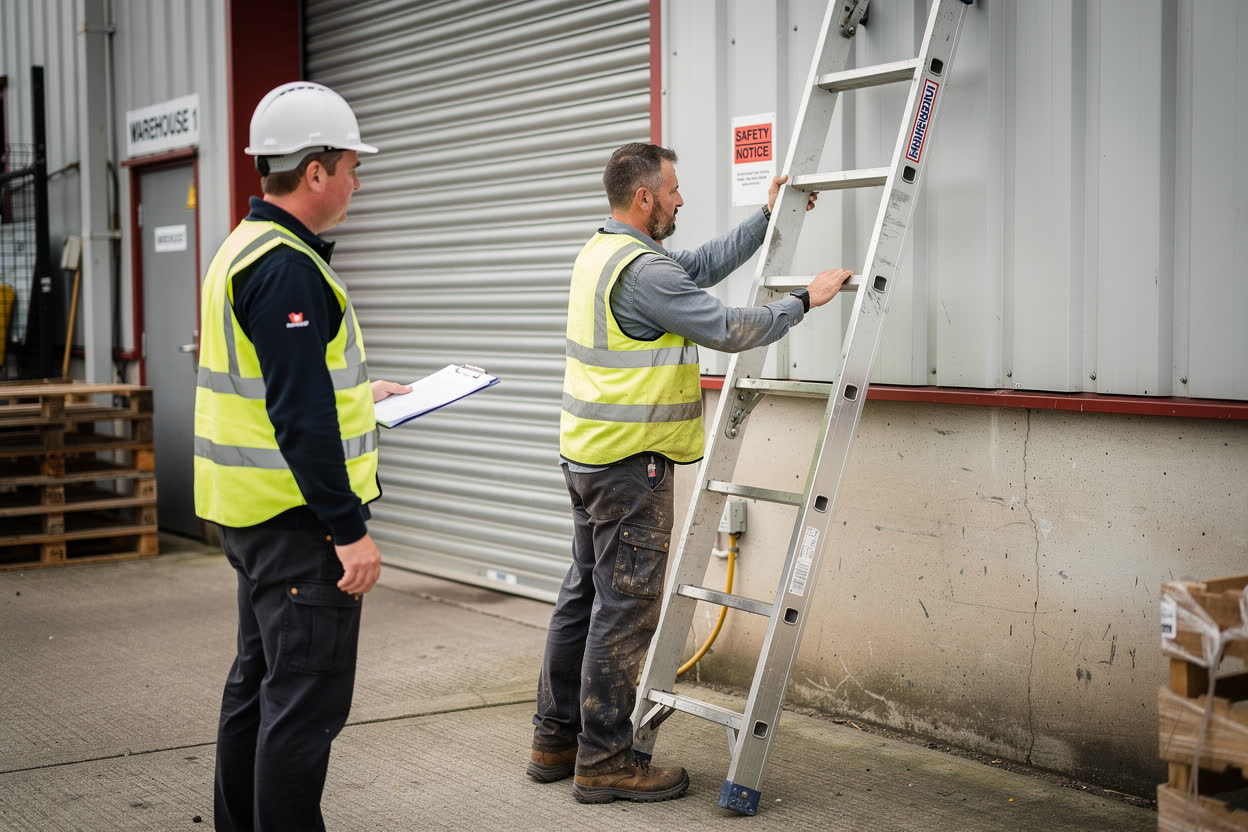
  • A portable ladder must be prevented from slipping during use, by securing the stiles at or near the top or bottom, by an effective anti-slip or stability device, or by an equally effective arrangement.
  • A ladder used for access must stick out far enough above the landing place, unless there is another secure handhold.
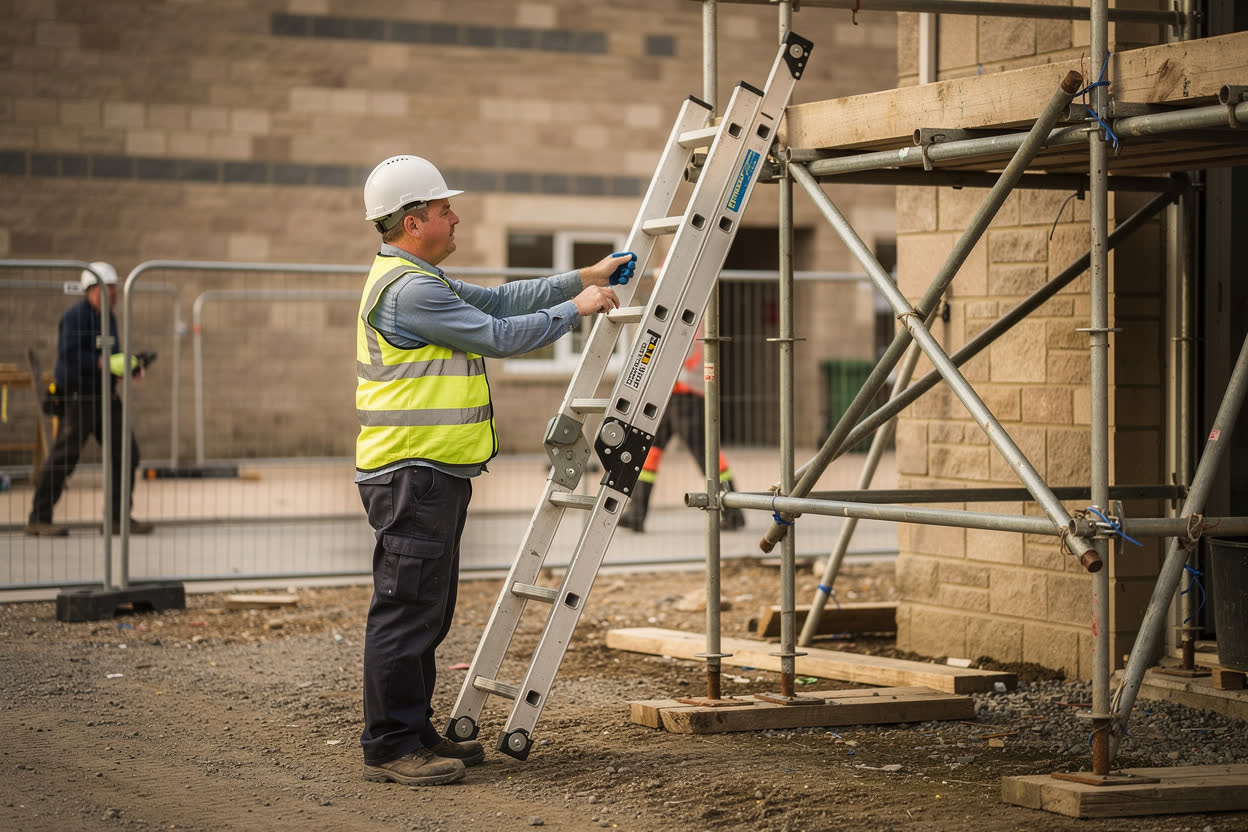
  • The sections of an interlocking or extension ladder must be prevented from moving against each other during use.
The Legal Requirements for Ladders: 8 to 10
  • A mobile ladder must be prevented from moving before anyone steps on it.
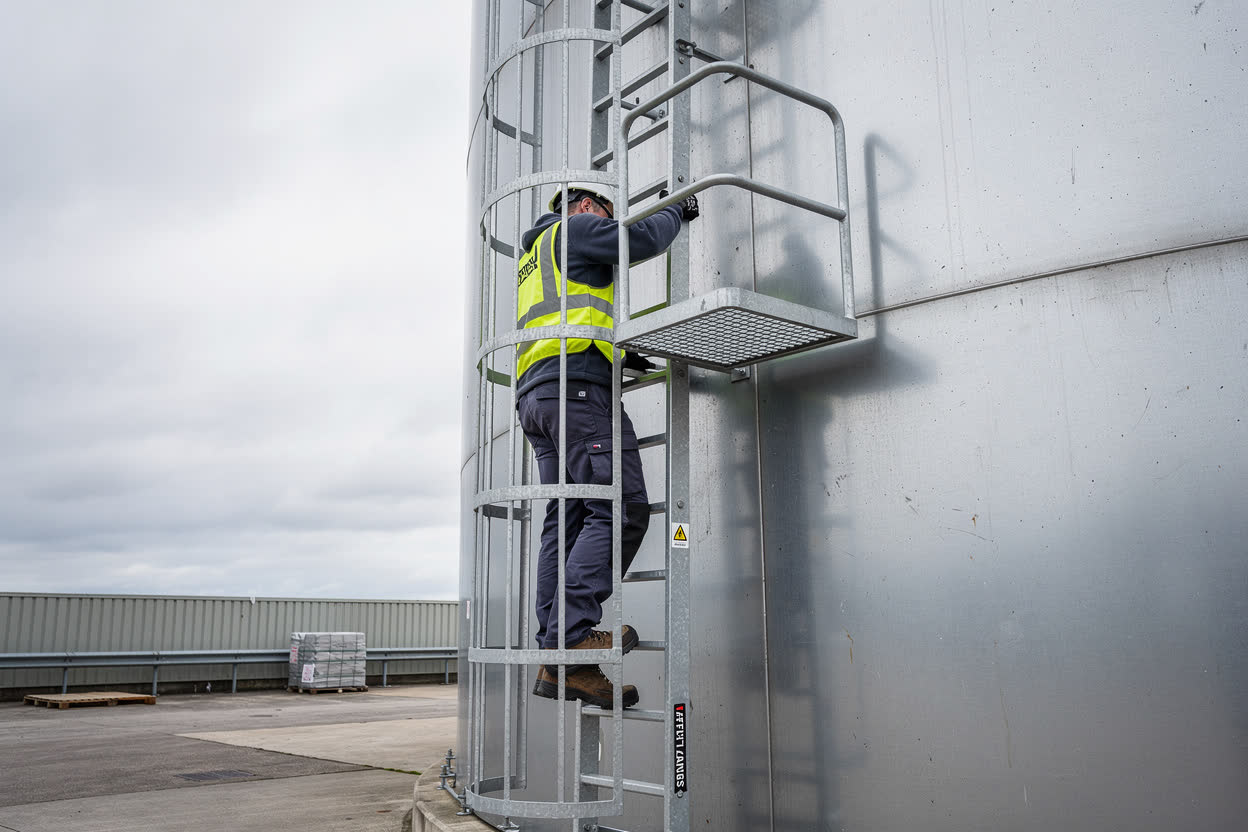
  • Where a ladder, or a run of ladders, rises nine metres or more, rest platforms must be provided at suitable intervals, where reasonably practicable.
  • Every ladder must be used so that the user always has a secure handhold and secure support, including while carrying a load.

There is one exception. On a stepladder, where a handhold is not practicable while carrying a load, the stepladder may still be used if a risk assessment shows the risk is low and the use is short.

Employee Duties
Employee Duties

The law does not put every duty on the employer. If you use ladders at work, you must also:

  • Use ladders and stepladders safely, as you have been trained and instructed.
  • Check equipment for damage, and never climb a damaged ladder.
  • Report faults and hazards without delay.
  • Make sure your work does not put other people at risk.
  • Co-operate with your employer on health and safety.
  • Tell your employer if you feel unwell, or are taking medication that could affect your safety at height.
Why Accidents Must Be Recorded

Keeping records of accidents at work is a legal requirement, and the HSE can ask to see them.

A good accident record gives the business the information it needs to make any report the law requires. It also shows whether the existing controls are working, or need to be changed, so that the same accident does not happen again.

Reporting Accidents
Reporting Accidents

Under the Reporting of Injuries, Diseases and Dangerous Occurrences Regulations 2013, or RIDDOR, employers must report to the HSE:

  • Deaths and specified injuries, without delay. These include fractures other than to fingers, thumbs and toes, amputations, injuries likely to cause loss of sight, crush injuries to the head or torso, and loss of consciousness from a head injury.
  • Injuries that keep a worker off normal work for more than seven consecutive days, not counting the day of the accident, within fifteen days.
  • Dangerous occurrences, and members of the public taken to hospital.
Reporting Quickly, and What Is Not Reportable
For the most serious cases, telephone the regulator, so the information is received at once.Serious dangerous occurrences, such as a collapse or a release that forces an evacuation, must be reported without delay.Everyday cuts and bruises, and injuries on the journey to work, are not reportable.
Reporting Quickly, and What Is Not Reportable

When a reportable accident happens, speed matters. A death, a specified injury or a dangerous occurrence goes to the Health and Safety Executive as quickly as it can be sent. That includes serious dangerous occurrences, such as a collapse or a release that forces an evacuation. For the most serious cases, telephoning is the best route, because the information is received straight away and can be acted on immediately. Remember that the reporting duty has limits.

Everyday cuts and bruises are not reportable, and neither is an injury suffered on the journey to work, for example in a road collision. They should still be recorded in the accident book, because a pattern of minor injuries can warn of a bigger problem.

What Goes into an Accident Record

Accident records must be kept securely and confidentially. Each entry should include:

  • The date the record was made.
  • The name, job title and contact details of the person making it.
  • The name and address of the company.
  • Where, when and at what time the incident happened.
  • The name, address and job title of everyone involved.
  • A description of the injury, illness or incident.
  • How and when it was reported to the HSE, where it was reportable.
The HSE and Local Authorities

The HSE enforces health and safety law in factories, building sites and other higher-risk workplaces. Local authorities enforce it in places such as shops, offices, warehouses and hotels. Inspectors can:

  • Enter and inspect workplaces, without notice.
  • Investigate accidents and complaints, and give advice.
  • Issue improvement notices and prohibition notices.
  • Prosecute companies, directors, managers and employees.
  • For the HSE only, charge a fee for intervention where they find a material breach of the law.
Summary

In this module, you have learned that:

The first priority is to avoid work at height. Where it cannot be avoided, falls must be prevented, and then their consequences minimised.

Ladders bought for work must meet EN 131, Professional class, with a maximum total load of 150 kilograms.

Employers must record accidents, and report deaths, specified injuries and over seven day injuries to the HSE under RIDDOR.

In the next module, we will look at risk assessment for ladder and stepladder work.

Knowledge Check
In the UK, which law controls work at height, including the use of ladders?
Select one answer, then press Check.
The Work at Height Regulations 2005
The Highway Code
The Food Safety Act 1990
Data protection law
Correct. The Work at Height Regulations 2005 control work at height in the UK.
Not quite. Think about the regulations that deal specifically with work at height. Try again.
Next Module →Answer the question to unlock the next module.
Page 1 of 21