← Exit
Module 5 · Secondary Illnesses and Conditions0% complete · 19 slides left
First Aid
First Aid
Module 5
This course contains audio. Use headphones in public places.
Introduction
Introduction

Like injuries, many illnesses and medical conditions can become life-threatening if they are not recognised and managed quickly.

In this module, you will learn to recognise and respond to asthma attacks, allergic reactions and anaphylaxis, diabetic emergencies, epileptic seizures, heart attacks and strokes.

Always get medical advice if you are unsure, or worried about a casualty. Many people with long-term conditions know how to manage them, so listen to them, and help them follow their own care plan.

Asthma
Asthma

Asthma is a condition of the airways. During an asthma attack, the muscles around the airways tighten, and the lining becomes swollen and inflamed, which makes it hard to breathe.

Asthma affects people of all ages. It often starts in childhood, and for many people it is lifelong. An attack can be triggered by:

  • Allergens, such as pollen, dust mites or animal fur.
  • Cold air, smoke, fumes or pollution.
  • Exercise, or a chest infection.

Sometimes there is no obvious trigger.

Recognising an Asthma Attack

Common signs of asthma include wheezing, which is a whistling sound when breathing, a persistent cough, shortness of breath, and a tight chest.

In a severe attack, look for:

  • Severe coughing and wheezing, or a chest so tight that the wheeze goes quiet.
  • Fast breathing, and difficulty speaking in full sentences.
  • A fast heart rate.
  • Drowsiness, confusion, exhaustion or dizziness.
  • Blue or grey lips or fingertips.
  • Collapse.
Helping Someone with an Asthma Attack
  • Stay calm, and reassure them. Help them to sit upright, and to take slow, steady breaths.
  • Help them use their reliever inhaler, which is usually blue, with a spacer if they have one.
  • They should take one puff every 30 to 60 seconds, up to 10 puffs.
  • If they do not improve, or you are worried at any time, call 999 or 112. If the ambulance has not arrived within 10 minutes, repeat the puffs.
  • Monitor their breathing and responsiveness. If they become unresponsive and stop breathing normally, start CPR.
Allergic Reactions and Anaphylaxis

An allergic reaction happens when the immune system over-reacts to something harmless, such as pollen, certain foods, insect stings, latex or medicines. Mild signs include sneezing, itchy watery eyes, a flushed face and a raised, itchy rash called hives.

Anaphylaxis is a severe, life-threatening allergic reaction, which can develop within minutes. Anaphylactic shock is caused by an allergy. Look for:

  • Swelling of the tongue, lips, mouth or throat.
  • Difficulty breathing or swallowing, wheezing or a hoarse voice.
  • Feeling faint or dizzy, pale clammy skin, and collapse.
Treating Anaphylaxis
  • Use the adrenaline auto-injector straight away, if they have one. Help them to use it, or give it yourself, following the instructions, into the outer thigh.
  • Call 999 or 112, and say that the casualty has anaphylaxis, and what probably caused it.
  • Lay them down, and raise their legs. If they are struggling to breathe, let them sit up instead. Do not let them stand or walk.
  • If there is no improvement after 5 minutes, give a second auto-injector, if one is available.
  • If they stop breathing normally, start CPR.
Diabetes
Diabetes

Diabetes is a long-term condition in which the body cannot control the level of sugar, or glucose, in the blood.

  • In type 1 diabetes, the body does not make insulin, so the person must take insulin.
  • In type 2 diabetes, which is more common, the body does not make enough insulin, or does not respond to it properly.

People with diabetes manage their blood sugar with diet, tablets or insulin. If the balance goes wrong, blood sugar can become dangerously low or high. Some people carry glucose tablets, a glucose meter or an insulin pen, or wear a medical alert bracelet.

Low Blood Sugar
Low Blood Sugar

Low blood sugar, called hypoglycaemia or a hypo, is the most common diabetic emergency. It can develop quickly, for example after missing a meal, after exercise, or after too much insulin.

Signs include:

  • Weakness, faintness and hunger.
  • Confusion, irritability or unusual behaviour, which can look like drunkenness.
  • Pale, cold, sweaty skin.
  • Trembling, and a fast pulse.
  • Becoming drowsy or unresponsive.
Treating Low Blood Sugar
  • Help them to sit down.
  • Give them something sugary, preferably a liquid, such as a sugary drink or fruit juice, or glucose tablets or gel. Drinks work faster than food.
  • If they improve, give more sugar, and then a snack such as a sandwich or biscuits. If they have a glucose meter, help them check their level.
  • Never give them insulin.
  • If they do not improve, or become drowsy, call 999 or 112. If they become unresponsive, give nothing by mouth, check their breathing, and place them in the recovery position.
High Blood Sugar
High Blood Sugar

High blood sugar, called hyperglycaemia, usually develops more slowly, over hours or days. Signs include:

  • Thirst, and passing urine often.
  • Warm, dry skin, and a fast pulse and breathing.
  • A sweet, fruity smell on the breath.
  • Tiredness, drowsiness or confusion.

Advise the person to get medical help promptly. If they are drowsy, being sick or unwell, call 999 or 112. Do not give insulin yourself. A person who is alert may manage it with their own medicine.

Epilepsy
Epilepsy

Epilepsy is a condition of the brain that causes recurrent seizures. A seizure is a sudden burst of electrical activity in the brain, which temporarily disrupts how it works.

Seizures vary, depending on which part of the brain is affected. Signs may include:

  • Sudden collapse, and becoming stiff with an arched back.
  • Jerking movements of the body, called convulsions.
  • Noisy breathing, and loss of bladder control.
  • Staring blankly, or strange sensations such as tingling or unusual smells.
Helping Someone Having a Seizure
  • Do not restrain them, and do not move them unless they are in danger.
  • Clear away hard or sharp objects, and anything hot.
  • Protect their head with something soft, and loosen tight clothing around the neck.
  • Never put anything in their mouth. Note the time the seizure started.
  • When it stops, check their breathing, place them in the recovery position, and stay with them. Be ready to start CPR.

Call 999 or 112 if it is their first seizure, it lasts more than 5 minutes, one seizure follows another, they are injured, or they have difficulty breathing.

Heart Attack
Heart Attack

A heart attack happens when the blood supply to part of the heart muscle is suddenly blocked, usually by a blood clot. It is a medical emergency, and the person can go into cardiac arrest. Signs include:

  • Chest pain, often in the centre, that feels like pressure, tightness or squeezing.
  • Pain spreading to the arms, jaw, neck, back or stomach.
  • Shortness of breath, sweating, nausea, dizziness, and a feeling of anxiety.

Women, older people and people with diabetes may have less typical symptoms, sometimes with little or no chest pain.

Angina and Indigestion

A heart attack can be mistaken for angina or indigestion.

Angina is chest pain caused by narrowed arteries that restrict the blood flow to the heart. It is usually brought on by exertion, stress or excitement, and eases with rest and the person’s own medicine, often within a few minutes.

Indigestion causes heartburn, bloating and nausea, usually after eating or drinking.

If chest pain does not ease quickly with rest and medicine, or you are not sure, treat it as a heart attack.

Helping Someone Having a Heart Attack
  • Call 999 or 112 for an ambulance straight away.
  • Help them into a comfortable half-sitting position, for example on the floor leaning against a wall, with their knees bent.
  • Unless they are allergic to it, or have been told not to take it, give them one 300 milligram aspirin tablet to chew slowly. Aspirin helps to thin the blood and reduce damage to the heart.
  • If they have their own angina medicine, help them to take it.
  • Reassure them, and monitor their breathing and responsiveness. Send for a defibrillator, and be ready to start CPR.
Stroke
Stroke

A stroke happens when the blood supply to part of the brain is cut off, by a clot or a burst blood vessel. Brain cells start to die within minutes, so fast treatment is vital. Think FAST:

  • Face: check whether one side of the face has fallen, and whether they can smile.
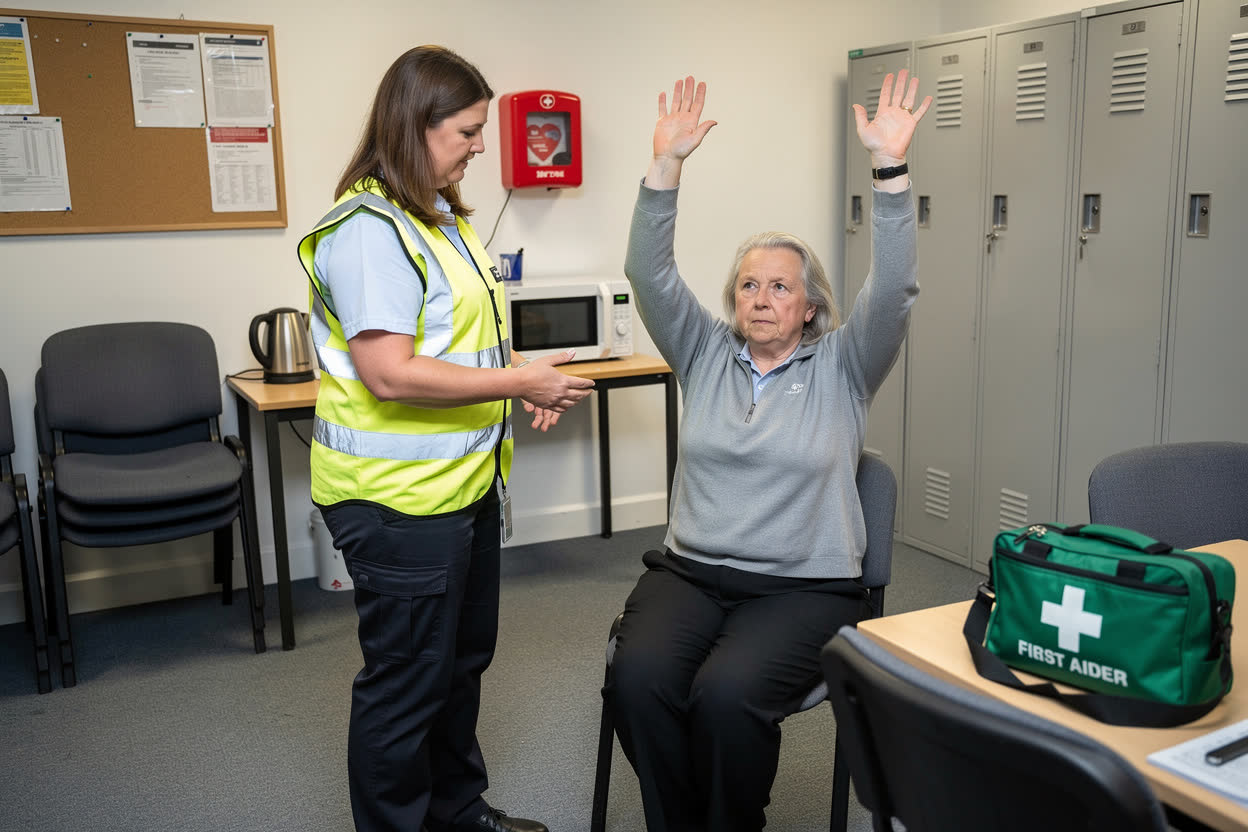
  • Arms: check whether they can raise both arms and keep them there.
  • Speech: listen for slurred or confused speech.
  • Time: if you see any of these signs, call 999 or 112 straight away.

Other signs include sudden loss of vision, numbness on one side, confusion, dizziness or a sudden severe headache.

Helping Someone Having a Stroke
  • Call 999 or 112, and say you think the person is having a stroke. Note the time the symptoms started.
  • Keep them comfortable and supported, so that they do not fall.
  • Do not give them anything to eat or drink, because their swallowing may be affected.
  • Reassure them, and monitor their breathing and responsiveness.
  • If they become unresponsive but are breathing normally, place them in the recovery position. If they stop breathing normally, start CPR.
Summary

In this module, you have learned that:

Severe coughing and wheezing are common signs of an asthma attack. Help the person use their reliever inhaler, one puff at a time, up to 10 puffs.

Anaphylactic shock is caused by an allergy. Use their adrenaline auto-injector and call an ambulance. For low blood sugar, give something sugary, preferably a drink.

Recurrent seizures are a sign of epilepsy. For a heart attack, call an ambulance and give aspirin. For a stroke, think FAST.

In the next module, we will look at further conditions, such as hyperventilation, nosebleeds, sprains, poisoning and drowning, and how to record and report incidents.

Knowledge Check
A person with diabetes is showing signs of low blood sugar. What should you do?
Select one answer, then press Check.
Give them something sugary, preferably a drink
Give them a dose of insulin
Stop them from eating or drinking anything
Ask them to walk around to keep active
Correct. A sugary drink raises the blood sugar quickly. Never give insulin, because it lowers blood sugar even further.
Not quite. Low blood sugar needs sugar, and liquids work fastest. Try again.
Next Module →Answer the question to unlock the next module.
Page 1 of 20