← Exit
Module 4 · CPR and Resuscitation0% complete · 14 slides left
First Aid
First Aid
Module 4
This course contains audio. Use headphones in public places.
Introduction
Introduction

Cardiopulmonary resuscitation, or CPR, is a life-saving technique for someone in cardiac arrest, when the heart has stopped pumping blood effectively. A person in cardiac arrest is unresponsive, and is not breathing normally.

Every minute without CPR and defibrillation reduces their chance of survival. Survival depends on a chain of actions: recognising cardiac arrest and calling for help early, starting CPR straight away, using a defibrillator as soon as possible, and expert care by the ambulance crew and hospital.

This module explains CPR for adults, children and babies, and how to use a defibrillator.

When to Give CPR
When to Give CPR

Start CPR straight away if a casualty is unresponsive and is not breathing, or is not breathing normally. Occasional, slow or noisy gasps are not normal breathing.

Do not give CPR to someone who is breathing normally, even if they are unresponsive. Place them in the recovery position, and keep checking their breathing.

CPR combines chest compressions with rescue breaths. If you have not been trained in rescue breaths, or are unable or unwilling to give them, give chest compressions only. This is much better than doing nothing.

Before You Start CPR
  • Check for danger, then for a response: speak loudly, and gently tap the shoulders.
  • Shout for help.
  • Open the airway with a head tilt and chin lift.
  • Check breathing for no more than 10 seconds.
  • If they are not breathing normally, call 999 or 112 for an ambulance before you start CPR. Put your phone on speaker, so that the call-taker can guide you.
  • Send someone to fetch the nearest defibrillator. If you are alone, do not leave the casualty to look for one. Start CPR.
Chest Compressions
Chest Compressions
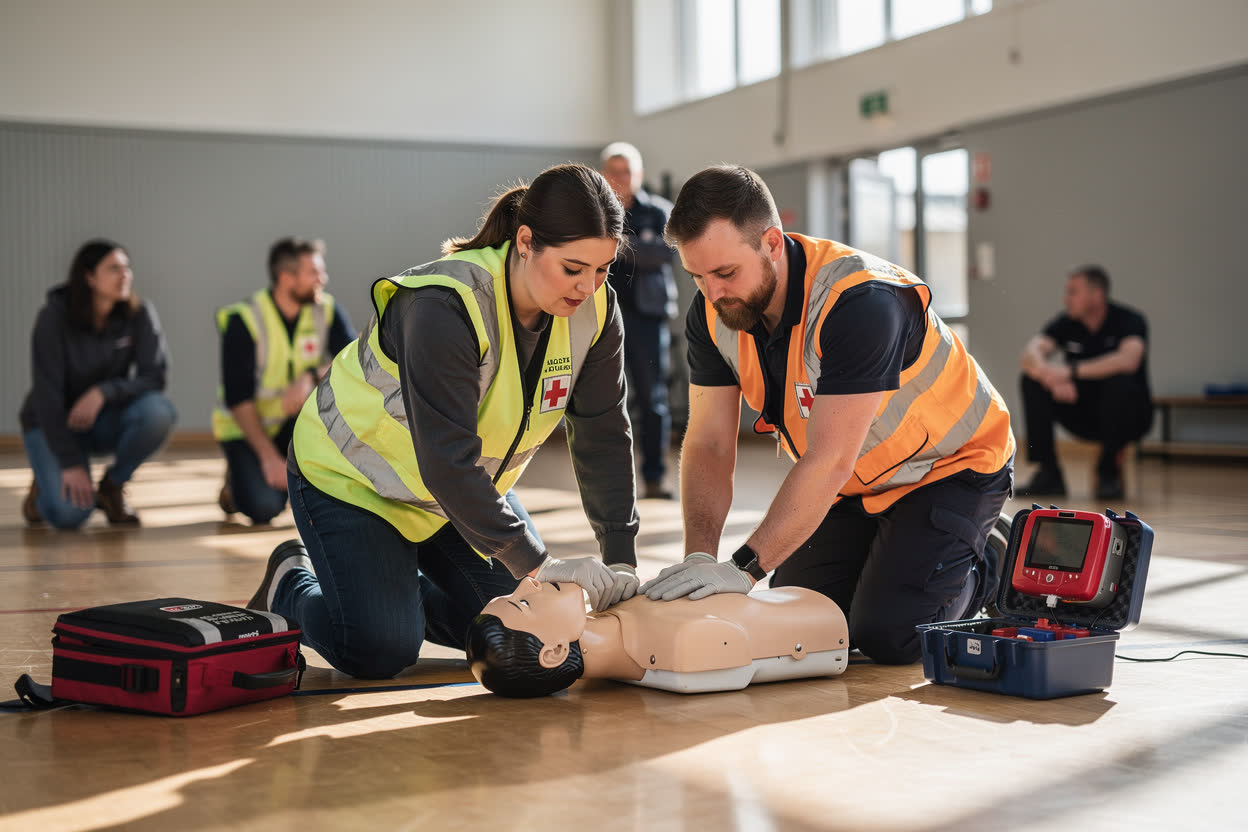
  • Make sure the casualty is lying on their back on a firm surface, and kneel beside their chest.
  • Place the heel of one hand in the centre of the chest, on the lower half of the breastbone.
  • Place your other hand on top, and interlock your fingers.
  • With your arms straight and your shoulders above your hands, press down 5 to 6 centimetres, then release fully.
  • Give 30 compressions at a rate of 100 to 120 per minute. That is about two each second, to the beat of a song like "Stayin’ Alive".
Rescue Breaths
Rescue Breaths

If you are trained and willing, give 2 rescue breaths after every 30 compressions:

  • Open the airway with a head tilt and chin lift.
  • Pinch the soft part of the nose closed.
  • Seal your lips around their mouth, ideally using a face shield or pocket mask.
  • Blow steadily for about one second, until the chest rises, then let it fall.
  • Give a second breath, then go straight back to compressions.

Continue with 30 compressions to 2 breaths. Do not let the breaths delay compressions by more than about 10 seconds.

When to Stop CPR
When to Stop CPR

Keep going with CPR until:

  • The casualty shows signs of life, such as opening their eyes, moving, coughing or speaking, and starts breathing normally.
  • A defibrillator tells you to stop, while it analyses the heart rhythm or delivers a shock.
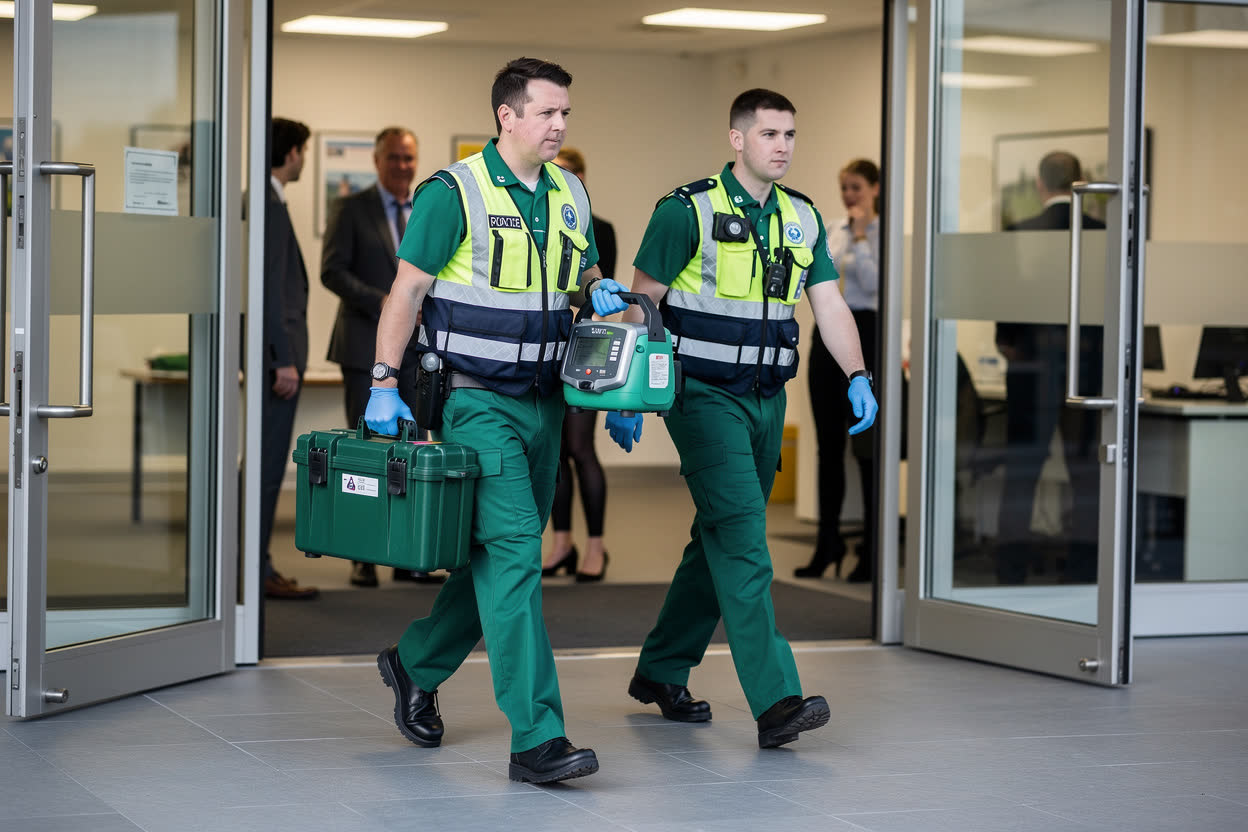
  • The ambulance crew arrives and takes over.
  • You are too exhausted to continue.

CPR is tiring. If there is another trained person, swap over about every 2 minutes, with as little pause as possible. If the casualty starts breathing normally, place them in the recovery position.

Defibrillators
Defibrillators

An automated external defibrillator, or AED, is a portable device that can give an electric shock through the chest to restore a normal heart rhythm in cardiac arrest.

Using an AED together with CPR greatly improves the chance of survival. Defibrillation within 3 to 5 minutes of collapse can produce survival rates as high as 50 to 70 per cent.

Many workplaces and public places now have AEDs. Find out where your nearest one is before you ever need it.

Using an AED
Using an AED

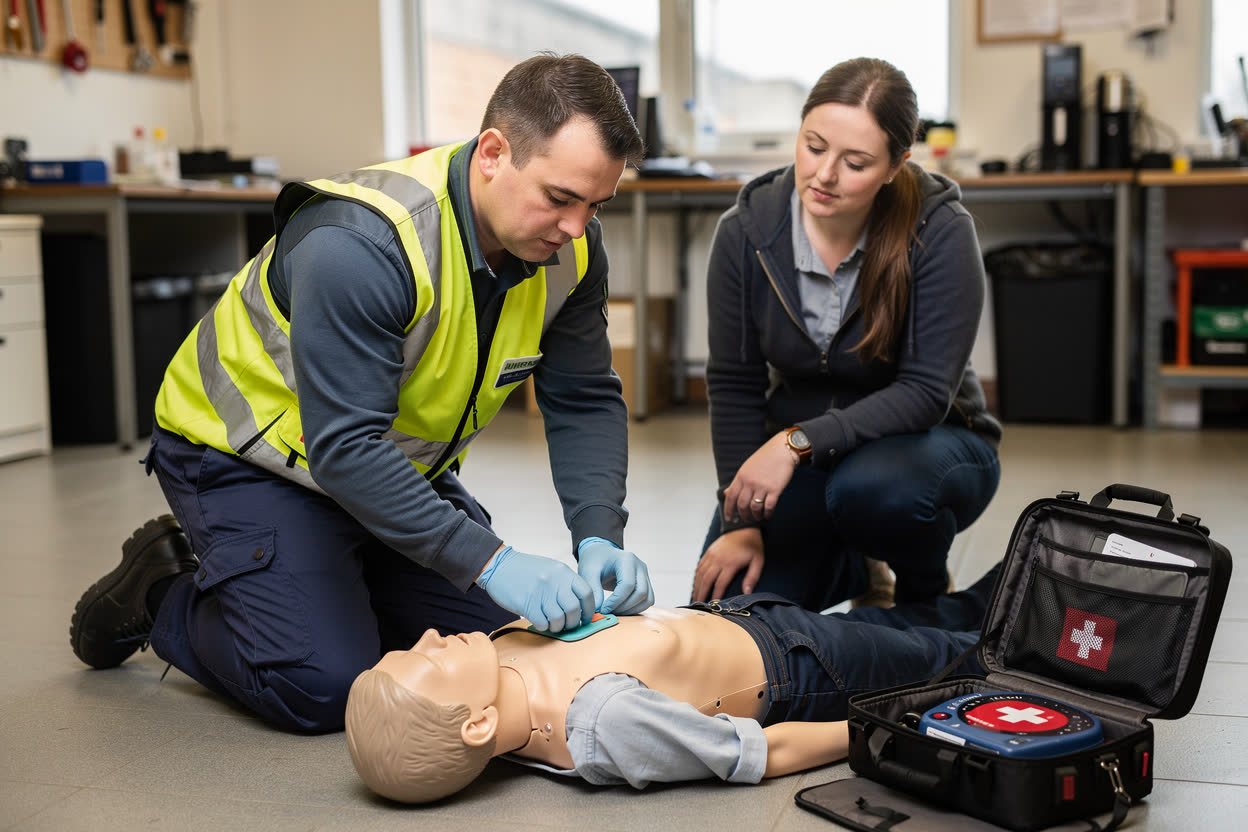
AEDs are designed to be used by anyone. They give clear voice instructions, and will only shock if a shock is needed.

  • Switch the AED on, and follow its instructions.
  • Expose the chest, and dry it if it is wet.
  • Attach one pad below the right collarbone, and the other on the left side, below the armpit, as shown on the pads.
  • Make sure nobody touches the casualty while the AED analyses the rhythm, and when it gives a shock.
  • Restart CPR straight away when told to, and keep following the instructions until help arrives.
CPR for Children
CPR for Children

For a child aged from 1 year to puberty, the steps are similar, with some changes:

  • Open the airway, and give 5 rescue breaths first.
  • Then give 30 chest compressions, using one hand, or two for a larger child, on the lower half of the breastbone.
  • Press down by at least one third of the depth of the chest, about 5 centimetres.
  • Continue with 30 compressions to 2 rescue breaths.

An AED can be used on a child. Use child pads or a child setting if the AED has them. If not, use the adult pads.

CPR for Babies
CPR for Babies

For a baby under 1 year old:

  • Keep the head in a neutral position, and do not tilt it back too far.
  • Give 5 rescue breaths first, sealing your mouth over the baby’s mouth and nose together, and using small, gentle puffs.
  • Then give 30 chest compressions in the centre of the chest, on the lower half of the breastbone. Use the two-thumb method: put your hands around the chest and press with both thumbs.
  • Press down by at least one third of the depth of the chest, about 4 centimetres.
  • Continue with 30 compressions to 2 rescue breaths.
Hygiene and Safety
Hygiene and Safety

The risk of catching an infection from giving CPR is very low. Protect yourself where you can, but never delay CPR to do so.

  • Wear disposable gloves, if they are to hand.
  • Use a face shield or pocket mask for rescue breaths, if you have one.
  • If you are not willing to give rescue breaths, give chest compressions only.
  • Afterwards, wash your hands and face thoroughly, and seek advice if you came into contact with blood or body fluids.
Special Cases
Special Cases

Take extra care if the casualty collapsed after a fall, a vehicle collision, a sports injury or a blow to the head, because they may have a spinal injury.

Keep the head and neck as still as you can while you open the airway, and if another person is available, ask them to hold the head steady. But remember, breathing comes first. If the casualty is not breathing normally, open the airway and start CPR.

In every case, call 999 or 112 straight away.

Summary

In this module, you have learned that:

If a casualty is unresponsive and not breathing normally, call 999 or 112, then start CPR. Do not give CPR to someone who is breathing normally.

Give 30 compressions, 5 to 6 centimetres deep, at 100 to 120 per minute, followed by 2 rescue breaths if you are trained.

Use an AED as soon as possible. It gives voice instructions, and greatly improves the chance of survival.

In the next module, we will look at medical conditions such as asthma, anaphylaxis, diabetes, epilepsy, heart attack and stroke.

Knowledge Check
How many chest compressions do you give before each pair of rescue breaths?
Select one answer, then press Check.
10
20
35
30
Correct. Give 30 compressions, 5 to 6 centimetres deep, at 100 to 120 per minute, then 2 rescue breaths.
Not quite. The ratio is 30 compressions to 2 rescue breaths. Try again.
Next Module →Answer the question to unlock the next module.
Page 1 of 15